

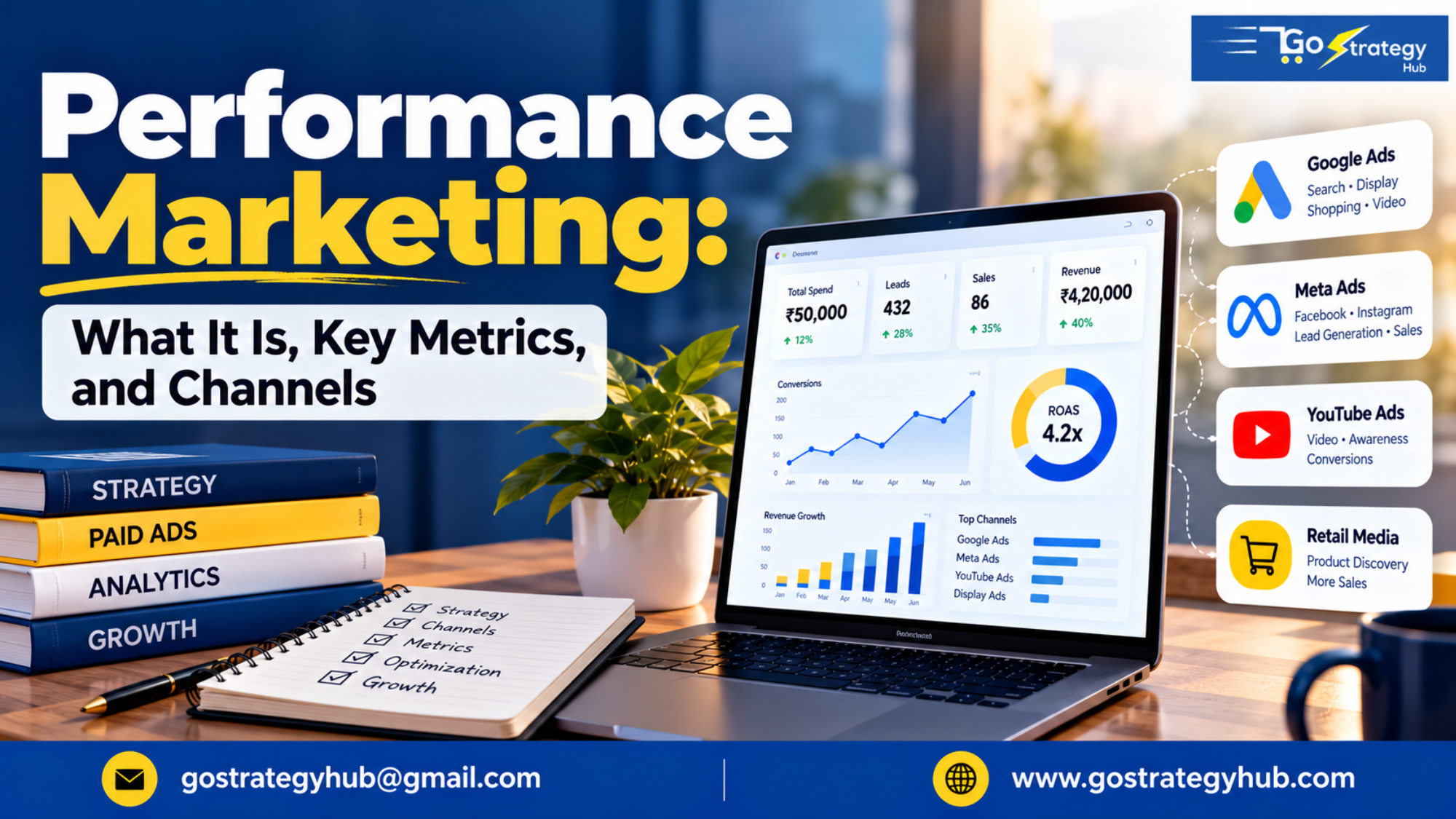
Performance marketing has changed the way businesses think about digital advertising.
Instead of focusing only on impressions, followers, or website traffic, businesses now want to know one thing:
What did we get from our marketing spend?
That is where performance marketing comes in.
Performance marketing is a results-focused approach to digital marketing. Campaigns are planned, tracked, and optimized around measurable actions such as clicks, leads, purchases, app installs, or revenue.
For businesses that want more control over their marketing budget, performance marketing can provide a clear way to measure what is working and what needs to change.
What Is Performance Marketing?
Performance marketing is a form of digital marketing where campaigns are measured against specific business outcomes.
The outcome can be different for every business.
For example:
- An e-commerce brand may focus on purchases.
- A real estate company may focus on qualified leads.
- A SaaS company may focus on demo bookings.
- An app company may focus on app installs.
- A service business may focus on calls or enquiries.
The main idea is simple:
Spend money, measure the result, learn from the data, and improve the campaign.
This makes performance marketing different from traditional advertising, where success can be harder to connect directly to a specific business result.
How Does Performance Marketing Work?
A performance marketing campaign usually follows a simple process.
1. Define the goal
Start with a clear business objective.
Do you want more sales, leads, calls, registrations, or app installs?
The goal should be measurable.
2. Choose the right channel
Different channels work for different audiences and buying journeys.
For example, Google Ads can capture existing search demand, while Meta Ads can help businesses create demand and reach new audiences.
3. Launch the campaign
Create the ads, audience strategy, landing page, offers, and tracking setup.
4. Measure the results
Track important metrics such as CPC, CPL, CPA, conversion rate, ROAS, and revenue.
5. Optimize
Use the data to improve targeting, creative, keywords, landing pages, offers, and budgets.
This cycle continues throughout the campaign.
Key Performance Marketing Metrics
Metrics help marketers understand whether a campaign is producing useful results.
Here are some of the most important ones.
Cost Per Click (CPC)
CPC tells you how much you pay for each click on your advertisement.
Formula:
CPC = Total Ad Spend ÷ Total Clicks
A lower CPC can be useful, but cheap clicks are not always valuable. The real question is whether those clicks lead to conversions.
Cost Per Lead (CPL)
CPL shows how much it costs to generate one lead.
Formula:
CPL = Total Ad Spend ÷ Number of Leads
This is especially important for businesses that depend on enquiries, calls, or form submissions.
Cost Per Acquisition (CPA)
CPA measures the cost of getting a customer or another defined conversion.
Formula:
CPA = Total Ad Spend ÷ Total Conversions
CPA is useful because it connects advertising spend with a specific business action.
Conversion Rate
Conversion rate shows the percentage of visitors who complete the desired action.
Formula:
Conversion Rate = Conversions ÷ Visitors × 100
For example, if 1,000 people visit a landing page and 50 become leads, the conversion rate is 5%.
Return on Ad Spend (ROAS)
ROAS measures the revenue generated from advertising spend.
Formula:
ROAS = Revenue from Ads ÷ Ad Spend
For example, if you spend ₹50,000 and generate ₹2,00,000 in tracked revenue, your ROAS is 4x.
ROAS is widely used by e-commerce and D2C businesses.
Customer Lifetime Value (LTV)
LTV looks beyond the first purchase.
It estimates how much revenue or profit a customer can generate during their relationship with the business.
This matters because a customer who buys repeatedly may be more valuable than a customer who makes only one purchase.
Main Performance Marketing Channels
Performance marketing is not limited to one advertising platform.
Businesses can use several channels depending on their goals and audience.
1. Google Ads
Google Ads is one of the most important performance marketing channels.
Search campaigns can reach people who are already looking for a product or service.
Other Google Ads campaign types can support shopping, video, display, app, and broader conversion goals.
The key advantage is the ability to connect advertising activity with measurable actions such as leads, purchases, calls, and revenue.
2. Meta Ads
Meta Ads can help businesses reach people across platforms such as Facebook and Instagram.
It is widely used for:
- Lead generation
- E-commerce sales
- Retargeting
- Product discovery
- Creative testing
- Customer acquisition
Creative quality plays a major role in Meta performance because users are often discovering products rather than actively searching for them.
3. Affiliate Marketing
Affiliate marketing is another performance-focused channel.
An affiliate promotes a product or service and receives a commission when a defined action occurs, such as a sale or lead.
It can help brands reach niche audiences without building every audience themselves.
4. Native Advertising
Native advertising places paid content in a format that fits naturally into the platform where it appears.
Examples include sponsored articles, recommendation placements, and other content-style advertisements.
The goal is to attract attention without disrupting the user’s experience.
5. Retail Media
Retail media allows brands to advertise through retailer platforms and use shopping-related data to reach relevant customers.
For D2C and consumer brands, retail media can connect advertising with product discovery and purchases.
6. Connected TV
Connected TV, or CTV, allows businesses to advertise through internet-connected televisions and streaming devices.
CTV combines the visual impact of television advertising with digital targeting and measurement.
It can support awareness as well as measurable actions further down the customer journey.
7. Social Commerce and Shoppable Video
Social commerce brings discovery and purchasing closer together.
A customer may discover a product through a social video and then purchase it without leaving the platform.
This reduces the number of steps between seeing a product and buying it.
Performance Marketing Is More Than Running Ads
One common mistake is to think performance marketing means simply running Google Ads or Meta Ads.
It is much broader than that.
A strong performance marketing system connects:
Ads → Creative → Landing Page → Conversion → Lead Qualification → Sales → CRM → Retention
For example, getting 1,000 leads sounds impressive.
But if the sales team can qualify only 50 of them and close five customers, the lead volume alone does not tell the full story.
That is why modern performance marketing needs to look beyond platform metrics.
The important question is:
Did marketing create profitable business growth?
How to Improve Performance Marketing
Better performance does not always come from increasing the advertising budget.
Start with the fundamentals.
Improve tracking
Make sure conversions are being tracked correctly.
Poor tracking can lead to poor decisions.
Improve creative
Test different hooks, formats, messages, offers, and calls to action.
Improve landing pages
A good advertisement can still fail if the landing page is slow, confusing, or difficult to use.
Focus on lead quality
Do not optimize only for the cheapest lead.
Look at which campaigns generate leads that actually become customers.
Connect marketing with CRM data
When possible, connect advertising data with sales and revenue data.
This gives marketers a better understanding of which campaigns create real business value.
Test continuously
Performance marketing is not a one-time setup.
Successful campaigns are tested, measured, and improved over time.
The Role of AI in Performance Marketing
AI is also changing how performance marketing is managed.
Advertising platforms can now automate areas such as bidding, targeting, budget allocation, and campaign optimization.
AI can also help marketers generate creative variations, analyze campaign data, identify patterns, and speed up testing.
But automation does not remove the need for strategy.
Businesses still need clear goals, reliable data, strong offers, good creative direction, and a clear understanding of their customers.
The marketer’s role is increasingly moving from manual campaign management toward strategy, analysis, experimentation, and business growth.
Final Thoughts
Performance marketing is ultimately about accountability.
It helps businesses connect marketing activity with measurable outcomes.
The most important metrics may include CPC, CPL, CPA, conversion rate, ROAS, and customer lifetime value. The right metrics depend on the business model and campaign objective.
The right channel also depends on the customer journey.
Google Ads, Meta Ads, affiliate marketing, native advertising, retail media, CTV, and social commerce can all play different roles in a performance marketing strategy.
But the biggest opportunity is not simply choosing more channels.
It is building a connected system where advertising, creative, landing pages, sales, CRM, and retention work together.
That is what turns performance marketing from ad spending into a measurable growth system.
