

Facebook Ads can help businesses reach new customers, generate leads, increase website traffic, and drive sales. But if you are new to paid advertising, getting started can feel confusing.
How much do Facebook Ads cost? Can you run them for free? How do you create your first campaign?
This Facebook Ads complete beginner’s guide answers these questions and explains the basics of creating and managing your first campaign.
What Are Facebook Ads?
Facebook Ads are paid advertisements that businesses use to promote their products, services, offers, or content.
You can create and manage these campaigns through Meta Ads Manager. Depending on your campaign setup, your ads can appear across Facebook, Instagram, and other available Meta placements.
Businesses commonly use Facebook Ads for:
- Lead generation
- Website traffic
- Online sales
- Brand awareness
- App promotion
- Engagement
- Retargeting
The main advantage of Facebook Ads is that you can reach specific audiences instead of showing your message to everyone.
How Much Do Facebook Ads Cost?
There is no fixed cost for Facebook Ads.
Your advertising cost depends on several factors, including your audience, industry, location, competition, campaign objective, creative, and budget.
You decide how much you want to spend. You can start with a small budget, collect data, and increase your spending when the campaign produces acceptable results.
However, don’t judge your campaign only by how much a click costs.
For example, a campaign with a low CPC may generate many clicks but very few customers. Another campaign may have a higher CPC but generate more valuable customers.
That is why you should look at the complete funnel.
Ad → Click → Conversion → Customer → Revenue
Some important Facebook Ads metrics include:
- CPM: Cost per 1,000 impressions
- CTR: Percentage of people who click your ad
- CPC: Cost per click
- Conversion Rate: Percentage of visitors who complete the desired action
- CPA: Cost per acquisition
- ROAS: Revenue generated compared with ad spend
The right metric depends on your business goal.
Can You Run Facebook Ads for Free?
You can use Facebook without paying for advertising.
For example, you can create a Facebook Page, publish posts, share videos, interact with your audience, and build organic engagement.
However, Facebook Ads are paid advertisements.
If you want Meta to distribute your content as a paid advertisement, you need an advertising budget.
The good thing is that you don’t need a large budget to begin testing. A controlled starting budget can help you understand your audience, creative performance, and conversion results before you increase your spending.
How to Run Facebook Ads for Beginners
If you are running Facebook Ads for the first time, keep your campaign structure simple.
1. Choose Your Campaign Goal
Start by deciding what you want your campaign to achieve.
For example:
- An e-commerce brand may want purchases.
- A service business may want leads.
- A local business may want enquiries.
- A website may want traffic.
Your campaign goal should match your actual business objective.
2. Define Your Target Audience
Next, decide who you want to reach.
Consider:
- Location
- Customer needs
- Interests
- Buying behaviour
- Existing customers
- Product or service relevance
Don’t choose an audience simply because it is large.
A relevant audience is more useful than a large but poorly targeted audience.
3. Create Your Ad Creative
Your creative is one of the first things people notice.
You can test different formats, including:
- Images
- Videos
- Reels
- Carousels
- Product demonstrations
- Educational content
- Offers
Your creative should quickly explain what you are offering and why the user should care.
A simple structure is:
Problem → Solution → Benefit → Call to Action
4. Set Your Budget
Set a budget that you can use comfortably for testing.
Avoid increasing your budget just because you receive clicks.
Look at what happens after the click.
Are people completing the desired action? Are leads qualified? Are customers generating enough revenue?
These questions are more important than traffic volume alone.
5. Add Your Ad Copy and CTA
Your ad copy should be easy to understand.
Start with a clear message, explain the problem or benefit, and finish with a relevant call to action.
For example:
Getting website visitors but not enough enquiries?
Improve the complete customer journey instead of focusing only on the ad.
CTA: Learn More
6. Track Your Results
Tracking is essential for understanding whether your campaign is working.
For an e-commerce business, you may track purchases and revenue.
For lead generation, you should eventually track lead quality and sales instead of measuring success only by the number of forms submitted.
How to Create a Facebook Ads Campaign


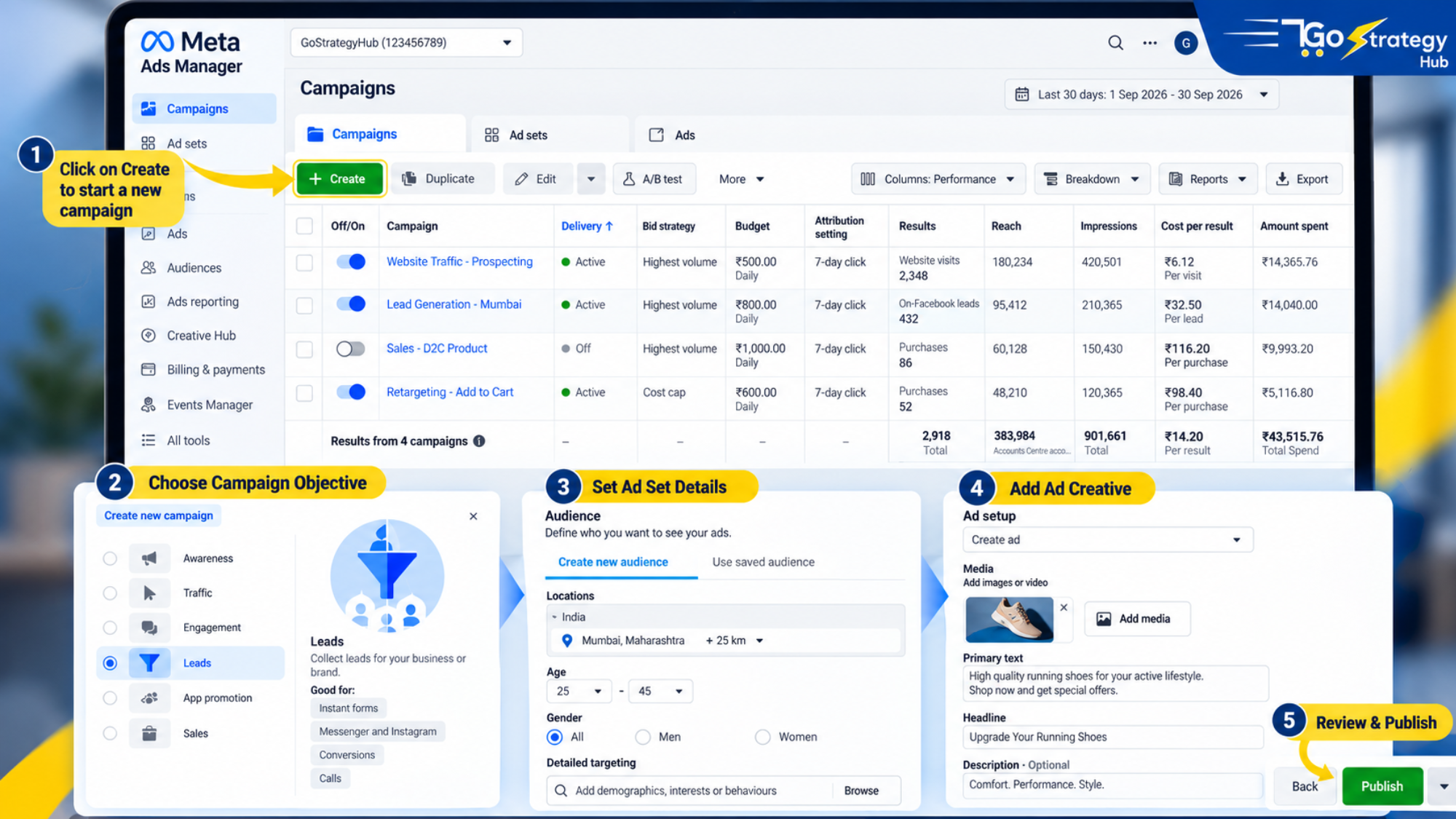
Meta Ads Manager screenshot showing the campaign creation and management process.
A typical Facebook Ads campaign has three main levels:
Campaign
This is where you define the overall campaign objective.
Ad Set
This is where you manage settings such as audience, budget, schedule, and placements.
Ad
This is where you add your creative, primary text, headline, destination, and call to action.
The exact options in Meta Ads Manager can change as Meta updates its advertising platform, so always check the current interface when creating a campaign.
Which Facebook Ads Metrics Should You Focus On?
Beginners often make the mistake of focusing on only one metric.
Instead, look at how the metrics connect.
CTR helps you understand whether your creative attracts attention.
CPC shows the cost of generating traffic.
Conversion Rate tells you how effectively that traffic converts.
CPA helps you understand acquisition cost.
AOV shows how much revenue you generate per order.
ROAS shows how much attributed revenue you generate compared with your advertising spend.
A campaign can have a good CTR and low CPC but still produce poor ROAS.
Why?
The traffic may not convert, the average order value may be low, or the overall business economics may not support the advertising cost.
This is why you should not optimize campaigns by looking at one number.
Facebook Ads Are Only One Part of the Funnel
Running ads is not the same as building a performance marketing system.
Your customer journey may look like this:
Ad → Landing Page → Offer → Conversion → Sales → Revenue → Repeat Purchase
If your ads generate clicks but your landing page doesn’t convert, changing the audience may not solve the problem.
If you generate leads but your sales team struggles to close them, reducing CPC will not necessarily improve revenue.
You need to understand the complete funnel.
Need Help With Facebook Ads?
If you are a business owner and need help creating, managing, or improving your Meta Ads campaigns, GoStrategyHub can help.
We are a performance marketing agency in Mumbai providing performance marketing services focused on measurable growth.
Our approach goes beyond running ads. We look at the complete journey from advertising and creative strategy to landing pages, conversions, CRM, automation, and customer retention.
Website: gostrategyhub.com
Email: gostrategyhub@gmail.com
Final Thoughts
Facebook Ads can be a useful channel for businesses that want to reach relevant audiences and generate measurable results.
You don’t need to understand everything before starting.
Begin with a clear goal, define your audience, create relevant ads, set a controlled budget, and track what happens after every click.
Most importantly, don’t focus only on getting cheap traffic.
Focus on turning that traffic into qualified leads, customers, revenue, and profitable growth.
