

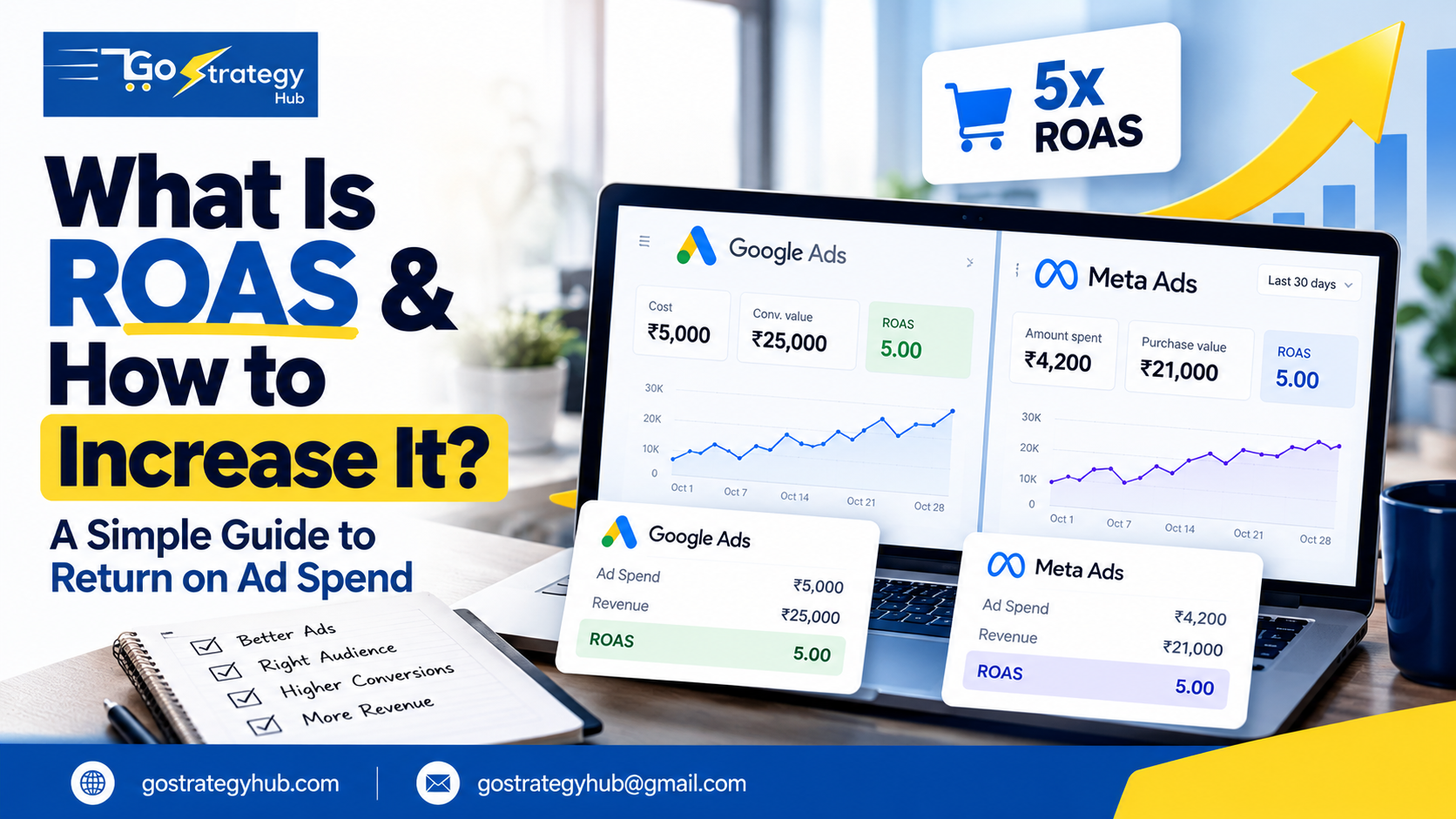
Are you spending money on ads but not sure how much revenue your business is generating from that spending?
ROAS can help you understand whether your performance marketing campaigns are generating revenue compared to your advertising costs.
For example, if you spend ₹1,000 on ads and generate ₹5,000 in sales, your ROAS is 5x.
But remember, generating ₹5,000 in sales does not mean you earned ₹5,000 in profit. You still need to pay for products, packaging, shipping, and other business expenses.
In this blog, we will explain what ROAS means, how to calculate it using a simple formula, and how to increase ROAS through practical performance marketing strategies.
What Is ROAS in Performance Marketing?
ROAS stands for Return on Ad Spend.
In performance marketing, ROAS measures how much revenue your advertising campaigns generate compared to the money you spend on ads.
It helps businesses evaluate the revenue performance of campaigns running on platforms such as Google Ads and Meta Ads.
For example, if your campaign generates ₹4 in revenue for every ₹1 spent on advertising, your ROAS is 4x.
ROAS helps you understand whether your advertising spend is generating revenue efficiently. However, you should also consider your product costs and profit margins before deciding whether a campaign is successful.
What Is the ROAS Formula?
The formula for calculating ROAS is simple:
ROAS = Revenue Attributed to Ads ÷ Advertising Spend
Let’s understand this with an example.
Suppose you run a Meta Ads campaign for your e-commerce business.
- Advertising spend: ₹2,000
- Revenue generated from ads: ₹10,000
Now, apply the formula:
ROAS = ₹10,000 ÷ ₹2,000
ROAS = 5x
This means your advertising campaign generated ₹5 in revenue for every ₹1 spent on advertising.
You can also express ROAS as a percentage.
ROAS (%) = (Revenue Attributed to Ads ÷ Advertising Spend) × 100
In this example:
ROAS = (₹10,000 ÷ ₹2,000) × 100
ROAS = 500%
Both 5x and 500% represent the same result.
Remember, a 500% ROAS does not mean a 500% profit. ROAS measures revenue against advertising costs, not total business expenses.
How to Calculate ROAS: A Simple Example
Imagine you sell natural honey, ghee, and cold-pressed oils through your website.
You spend ₹5,000 on performance marketing campaigns to generate online purchases.
Here are your results:
| Metric | Amount |
|---|---|
| Advertising spend | ₹5,000 |
| Revenue attributed to ads | ₹25,000 |
| ROAS | 5x |
| Revenue minus ad spend | ₹20,000 |
Your ROAS is ₹25,000 ÷ ₹5,000 = 5x.
You generated ₹25,000 in revenue by spending ₹5,000 on advertising.
However, the remaining ₹20,000 is not your final profit. You must still deduct product costs, packaging, shipping, payment fees, discounts, and other applicable expenses.
This is why performance marketers should evaluate ROAS alongside profitability.
What Is a Good ROAS in Performance Marketing?
There is no single ROAS target that works for every business.
A good ROAS depends on your product margins, average order value, operating costs, business model, and growth goals.
For example:
- 1x ROAS: ₹1 in revenue for every ₹1 spent on ads.
- 2x ROAS: ₹2 in revenue for every ₹1 spent on ads.
- 4x ROAS: ₹4 in revenue for every ₹1 spent on ads.
- 6x ROAS: ₹6 in revenue for every ₹1 spent on ads.
But is a 2x ROAS bad? Not always.
A business with high profit margins might be profitable at 2x ROAS, while a business with low margins might lose money even at 4x ROAS.
How to Calculate Your Break-Even ROAS
Break-even ROAS is the ROAS at which your revenue covers advertising costs and the other costs included in your calculation, leaving no profit or loss.
A simplified formula is:
Break-Even ROAS = 1 ÷ Contribution Margin Before Ad Spend
Suppose your contribution margin before advertising is 40%, after accounting for product and other variable costs.
Break-even ROAS = 1 ÷ 0.40
Break-Even ROAS = 2.5x
This means you need approximately ₹2.50 in revenue for every ₹1 spent on advertising to cover those costs.
Any ROAS above 2.5x may contribute to profit, while a ROAS below 2.5x may result in a loss, depending on your remaining expenses and how your margin was calculated.
Knowing your break-even ROAS helps you set a realistic target instead of blindly chasing a high number.
How to Increase ROAS in Performance Marketing
Increasing ROAS does not always mean reducing your advertising budget. The goal is to generate more valuable revenue from your advertising spend while maintaining healthy profit margins.
Here are seven practical strategies to improve ROAS.
1. Check Your Conversion Tracking First
Before optimizing your campaigns, check whether your tracking is recording the correct results.
For e-commerce businesses, purchase tracking should capture the correct order value and currency.
Depending on your setup, you might use the Google tag, Google Tag Manager, Meta Pixel, or other supported tracking integrations.
Check the following:
- Are purchases being recorded correctly?
- Is the correct purchase value being sent?
- Are duplicate purchases inflating your results?
- Does the revenue reported by your ad platform make sense compared with your store data?
- Are you comparing the same date range and attribution settings?
If your tracking data is incorrect, you might increase the budget on a campaign that is not actually generating profitable sales.
Better tracking leads to better performance marketing decisions.
2. Focus on Products That Generate Better Returns
Not every product in your store will perform equally well.
One product might generate many clicks but very few purchases. Another might generate fewer clicks but bring in more revenue and better margins.
Review product-level performance to understand which products generate valuable sales.
For example, suppose your store sells honey, ghee, and cold-pressed oils.
If a ghee campaign consistently generates profitable purchases while another product campaign attracts traffic without sales, investigate the difference before allocating more budget.
For Google Shopping and Performance Max, review product performance, product feed quality, and purchase value. For Meta Ads, test creatives that highlight relevant products and offers.
Do not increase the budget based on ROAS alone. Consider profit margins, order volume, and whether the results are consistent.
3. Improve Your Ad Creatives
Your advertisement needs to give people a clear reason to consider buying your product.
In Meta Ads, test different creative formats and approaches, such as:
- Product demonstration videos
- Product images
- Carousel ads
- Customer questions and answers
- Product comparisons
- Problem-and-solution creatives
For Google Search Ads, write relevant headlines and descriptions that match the customer’s search intent and clearly explain the product or offer.
For example, instead of creating a generic advertisement for honey, show the product, explain its relevant features, and make it easy for customers to understand what they are purchasing.
Test different creatives and compare their purchase performance. Do not judge an advertisement only by its likes, views, or click-through rate.
4. Improve Your Website Conversion Rate
Sometimes, your performance marketing campaign is generating relevant traffic, but visitors are not completing their purchases.
The problem might be on your website.
Customers may leave because the page loads slowly, the product information is unclear, delivery charges appear unexpectedly, or the checkout process is difficult.
To improve conversions:
- Make your website easy to use on mobile.
- Use clear product images and descriptions.
- Display pricing and delivery details clearly.
- Explain shipping, returns, and refunds.
- Make the checkout process simple.
- Answer common customer questions.
- Ensure your payment process works properly.
If more relevant visitors complete their purchases without a proportional increase in ad spend, ROAS can improve.
5. Target Customers With Relevant Purchase Intent
More traffic does not automatically mean more sales.
Your campaign might attract people who are curious about your product but are not ready to purchase.
For Google Ads, review search terms and reduce irrelevant traffic where appropriate. Focus on searches that match the products you sell and the intent of potential customers.
For Meta Ads, test different creative angles and audience strategies. Use purchase data to understand which approaches generate valuable customers.
Avoid optimizing only for low cost per click or low cost per lead when your actual goal is online sales.
A cheaper click is not useful if the visitor never purchases.
6. Increase Average Order Value
Average order value (AOV) is the average amount a customer spends per order.
You can sometimes increase ROAS by encouraging customers to purchase more in a single transaction.
For example, if a customer usually buys one bottle of cold-pressed oil, you could test a relevant two-bottle bundle or a combination of complementary products.
Other approaches include:
- Product bundles
- Relevant cross-selling
- Volume discounts
- Free-shipping thresholds, where profitable
- Complementary product recommendations
Suppose your advertising spend stays at ₹2,000. If your campaign generates more revenue because customers purchase larger baskets, your ROAS may increase.
However, check the additional product, discount, and shipping costs. More revenue does not always mean more profit.
7. Optimize Campaigns Using Purchase Data
Performance marketing is not just about launching campaigns and checking clicks. It involves measuring results and making decisions based on business objectives.
Review metrics such as:
- Advertising spend
- Purchase revenue
- ROAS
- Number of purchases
- Cost per purchase
- Average order value
- Profit margin
For e-commerce campaigns, purchase value is often more useful than counting every purchase as equally valuable.
For example, if one campaign generates ten orders worth ₹10,000 and another generates ten orders worth ₹20,000 at the same advertising cost, the second campaign has generated more revenue.
Use an appropriate evaluation period and account for conversion delays, promotions, and changes in demand. Avoid making major budget changes based on one unusually good or bad day.
ROAS vs ROI: What Is the Difference?
ROAS and ROI are related, but they measure different things.
ROAS measures advertising-attributed revenue compared with advertising spend.
ROI measures the return on an investment relative to its cost. In a business setting, the calculation should account for the relevant costs and clearly define what counts as the return.
For example, if you spend ₹5,000 on advertising and generate ₹25,000 in attributed revenue:
ROAS = ₹25,000 ÷ ₹5,000 = 5x.
But if your product costs, shipping, and other expenses are high, the actual profit may be small or even negative.
This is why performance marketers should track ROAS alongside profitability rather than treating ROAS as the final measure of business success.
Final Thoughts
ROAS is an important metric in performance marketing because it helps you understand how much revenue your advertising campaigns generate for every rupee spent.
To increase ROAS, start by checking conversion tracking, identifying stronger products, improving ad creatives, fixing website issues, attracting relevant customers, and testing ways to increase average order value.
Most importantly, do not chase a high ROAS number without understanding your profit margins.
A campaign that generates sustainable, profitable sales is often more valuable than one that shows an impressive ROAS but contributes very little to your business.
Performance marketing works best when you measure the complete journey, from advertising and website visits to purchases, revenue, and profitability.
Looking for a performance marketing agency in Mumbai? GoStrategyHub helps businesses improve their Google Ads and Meta Ads strategies with a focus on tracking, conversion optimization, and sustainable growth.
