

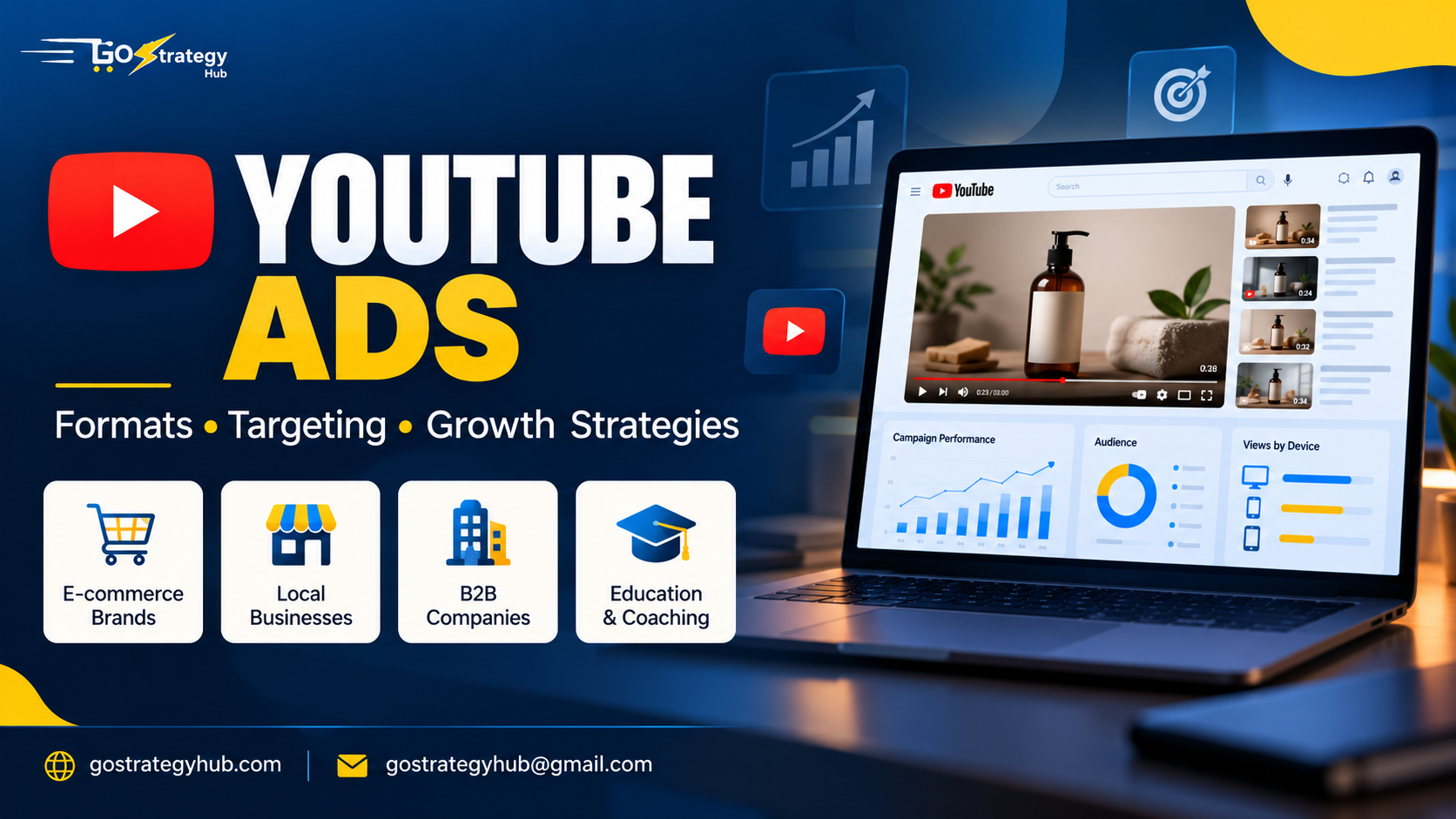
Have you ever watched a YouTube video and discovered a new product, service, or business through an advertisement?
That is the power of YouTube Ads.
YouTube Ads allow businesses to promote their products and services through video advertising. Businesses can reach people who are watching educational videos, product reviews, entertainment content, tutorials, and other videos related to their interests.
But here is an important question: Can every business benefit from YouTube Ads?
The answer is yes, many different types of businesses can use YouTube Ads, but the strategy depends on their business model, target audience, budget, and marketing objective.
In this guide, we will explain which businesses should run YouTube Ads, the different types of ads, and practical strategies for generating leads, increasing sales, and growing a business.
What Are YouTube Ads?
YouTube Ads are advertisements that businesses run through Google Ads to reach potential customers on YouTube and, depending on the campaign settings, eligible Google video partner placements.
Businesses can use these advertisements to:
- Increase brand awareness.
- Generate leads for their services.
- Sell products through an e-commerce website.
- Promote a new product or service.
- Increase website traffic.
- Reach potential customers through educational or product-related videos.
- Retarget people who have previously interacted with their business.
For example, a furniture brand can show a video of its latest sofa collection to people interested in home interiors. A digital marketing agency can promote its services to business owners who are learning about online advertising.
The objective is not simply to get more video views. It is to reach the right audience and encourage them to take the next step.
Which Types of Businesses Should Run YouTube Ads?
YouTube advertising can support different business models. However, each business needs a different campaign strategy.
1. E-commerce and D2C Brands
E-commerce businesses can use YouTube Ads to demonstrate products, explain their benefits, and introduce their brands to potential buyers.
Suitable businesses include:
- Clothing and fashion brands
- Beauty and skincare brands
- Organic food and grocery brands
- Home decor and furniture stores
- Electronics and accessories brands
- Fitness equipment brands
- Personal care brands
Example: Imagine an online brand selling natural honey and cold-pressed oils.
Instead of showing only a product image, the brand can create a video demonstrating the product, explaining how it is used, showing its packaging, and directing interested viewers to the product page.
Recommended strategy: Use product demonstration videos, YouTube Shorts, Demand Gen campaigns where suitable, and remarketing to previous website visitors.
The campaign should focus on purchases when the website, conversion tracking, and available conversion data support sales optimization.
2. B2B Companies
B2B companies often sell products or services that require research and consideration before a customer makes a decision.
Examples include:
- SaaS companies
- IT service providers
- Manufacturing companies
- Business consultants
- CRM software providers
- Recruitment and HR service companies
- Enterprise technology providers
Example: A company selling CRM software can create a video showing how sales teams lose leads when they manage customer information through spreadsheets.
The video can demonstrate how the CRM helps organize leads and track follow-ups, followed by a call to action to book a product demo.
Recommended strategy: Create educational videos, target relevant professional interests and content where available, send qualified visitors to a dedicated landing page, and measure demo requests rather than video views alone.
3. Local Businesses
Local businesses can use YouTube Ads to introduce their services to people in specific locations.
Examples include:
- Restaurants and cafes
- Dental clinics
- Gyms and fitness studios
- Interior designers
- Coaching institutes
- Real estate agencies
- Wedding photographers
- Home renovation services
Example: An interior design company serving Mumbai can show a video featuring a completed apartment project, its design process, and the types of projects it handles.
The advertisement can direct interested viewers to a consultation form or WhatsApp contact option on the website.
Recommended strategy: Use relevant geographic targeting, showcase real projects, communicate the service area clearly, and track qualified enquiries.
4. Education and Coaching Businesses
Education businesses can use YouTube Ads to promote courses, workshops, training programs, and educational services.
Examples include:
- Online course creators
- Coaching institutes
- Language training centers
- Professional certification providers
- Coding boot camps
- Career development programs
Example: A coaching institute can create a short video explaining its teaching method, course structure, and learning format.
Instead of immediately asking viewers to purchase a course, the business could offer a free demo class or introductory session.
Recommended strategy: Use educational content to attract relevant audiences, then follow up with people who express interest through a landing page or lead form.
5. Real Estate Businesses
Buying property usually involves research, comparison, and multiple interactions before a customer makes a decision.
Real estate businesses can use YouTube Ads to showcase:
- Property walkthroughs
- Apartment layouts
- Location and nearby facilities
- Project amenities
- Construction progress
- Virtual tours
Example: A real estate developer can create a video walkthrough of an apartment project and direct interested viewers to a page where they can request a site visit.
Recommended strategy: Combine project videos with location-based targeting, dedicated landing pages, lead qualification, and sales follow-up.
6. Healthcare and Wellness Businesses
Clinics, wellness centers, and other eligible healthcare businesses can use video advertising to explain their services and introduce their facilities.
Examples include physiotherapy centers, diagnostic services, and eligible wellness providers.
Example: A physiotherapy clinic can publish an educational video explaining its consultation process and the types of services it offers.
Recommended strategy: Focus on useful educational content, location relevance, and appointment enquiries. Healthcare advertising must comply with Google’s healthcare, personalization, and other applicable advertising policies.
Types of YouTube Ads
Choosing the right ad format is important because different formats serve different purposes.
1. Skippable In-Stream Ads
These ads appear before, during, or after eligible videos. Viewers can generally skip them after five seconds.
They are useful when a business wants to explain a product, demonstrate a service, or tell a longer story.
Best suited for: E-commerce brands, B2B companies, education providers, and service businesses.
Strategy: Communicate the problem, product, or key benefit within the first five seconds. Do not make viewers wait until the end to understand what the advertisement offers.
2. Non-Skippable In-Stream Ads
These advertisements play before, during, or after eligible videos, and viewers cannot skip them.
They are generally more suitable for delivering a short, controlled message to a broad audience.
Best suited for: Established brands, product launches, and campaigns focused on awareness.
Strategy: Keep the message clear and concise. Focus on one key idea rather than explaining everything about the business.
3. In-Feed Video Ads
These ads can appear in YouTube search results, alongside related videos, and in eligible home or discovery feeds. They typically use a thumbnail and text to encourage people to choose to watch the video.
Best suited for: Educational businesses, product reviews, tutorials, and businesses with informative video content.
Strategy: Create a relevant thumbnail and title that match what the audience wants to learn or discover.
4. YouTube Shorts Ads
Shorts ads appear between organic videos in the Shorts feed and provide a mobile-focused advertising format.
Best suited for: D2C brands, fashion businesses, food brands, beauty products, and businesses with visually engaging offers.
Strategy: Use vertical videos, demonstrate the product quickly, and include a clear next step. Make the advertisement feel natural to the short-video environment without misleading viewers.
5. Bumper Ads
Bumper ads are short, non-skippable video advertisements, typically six seconds long.
Best suited for: Brand awareness, product reminders, and reinforcing a campaign message.
Strategy: Communicate one memorable message, such as a brand name, product category, or campaign idea.
Google also offers other video advertising options, including Masthead placements for eligible campaigns. Availability and campaign requirements vary by format.
YouTube Ads Strategies for Different Business Goals
Selecting an ad format is only one part of the campaign. The bigger decision is what you want the campaign to achieve.
Strategy 1: Brand Awareness
Use this strategy when your business is new or your target audience does not know your brand.
Start with a clear message that explains what your business sells and who it serves.
For example, a new skincare brand can introduce its product range through short product demonstrations and longer explanatory videos.
Measure reach, impressions, frequency, and relevant video engagement. Do not judge the entire campaign by purchases alone if awareness is the primary objective.
Strategy 2: Lead Generation
This strategy works well for service businesses, B2B companies, real estate developers, and education providers.
A practical approach is:
- Identify the audience you want to reach.
- Create a video that addresses a relevant customer problem.
- Offer a useful next step, such as a consultation, product demo, or course introduction.
- Send interested viewers to a relevant landing page.
- Track enquiries and qualify the leads through your CRM.
For example, a performance marketing agency can advertise a video explaining why businesses receive leads but struggle to convert them into sales. The CTA can invite interested business owners to request a campaign review.
The key metric is not just the number of leads. It is the number of qualified leads that progress toward becoming customers.
Strategy 3: E-commerce Sales
For online stores, the campaign should connect the product demonstration with the buying process.
A practical strategy includes:
- Showing how the product works.
- Highlighting relevant product features.
- Directing viewers to the correct product page.
- Testing different creative approaches.
- Tracking purchases and revenue.
- Evaluating cost per acquisition and return on ad spend.
For example, a home decor brand can test a room transformation video against a product close-up video.
If the transformation video generates more purchases at an acceptable cost, the business can use that insight to guide future creative testing.
Do not assume the video with the most views will generate the most sales.
Strategy 4: Remarketing
Some people visit your website or watch your videos but do not take action immediately.
Remarketing can help eligible businesses reconnect with previous visitors or people who have interacted with their content, subject to available audience options, consent requirements, and Google’s advertising policies.
For example, someone visits a product page but does not purchase. A later advertisement can highlight the product’s features or explain how it is used.
Measure whether remarketing produces additional conversions at a sustainable cost rather than assuming every returning customer was caused by the advertisement.
Strategy 5: Use YouTube Alongside Google Search Ads
YouTube and Google Search can support different stages of the customer journey.
A potential customer may discover a brand through a YouTube video and search for the brand or product later.
A combined strategy can include:
- YouTube Ads to introduce the product or service.
- Google Search Ads to capture relevant search demand.
- A landing page that clearly explains the offer.
- Conversion tracking to measure leads or purchases.
- CRM reporting to understand which enquiries become customers.
The goal is to evaluate how the channels work together, not to assume that every conversion should be credited to the last ad someone clicked.
How to Target the Right Audience on YouTube
YouTube advertising can use several audience and content signals, depending on the campaign type and available settings.
Demographic and Geographic Targeting
Reach relevant age groups, locations, and other available demographic segments where appropriate.
This can be useful for local businesses or companies that sell only in specific markets.
Interests and Audience Segments
Use relevant audience segments to reach people whose interests or activities align with the product or service.
For example, a fitness equipment brand might test relevant fitness-related audience segments.
Custom Segments
Depending on the campaign type, custom segments can help reach people based on relevant search terms, interests, or other available signals.
For example, a business selling CRM software could test signals related to CRM tools, sales automation, and lead management.
These signals do not guarantee that every person has immediate purchase intent.
Placement and Content Targeting
Where supported, businesses can select relevant YouTube channels, videos, topics, or content contexts.
For example, a camera retailer could explore placements related to photography tutorials and camera reviews.
Use targeting options that are available for the selected campaign type. Not every audience or placement option is supported in every YouTube campaign.
How to Measure YouTube Ads Performance
A campaign can generate thousands of views and still fail to produce meaningful business results.
Choose metrics according to your objective.
| Campaign objective | Important metrics |
|---|---|
| Brand awareness | Reach, impressions, frequency |
| Video engagement | Views, view rate, engagement |
| Website traffic | Clicks, sessions, engaged visits |
| Lead generation | Qualified leads, cost per lead, lead-to-sale rate |
| E-commerce sales | Purchases, CPA, revenue, ROAS |
| Business growth | Sales opportunities, customer acquisition cost, revenue |
For lead generation, connect your advertising data with your CRM wherever possible. This helps you understand whether leads become sales opportunities and paying customers.
For e-commerce, ensure purchase tracking is configured correctly before making major optimization decisions.
Common YouTube Ads Mistakes to Avoid
1. Running ads without a clear objective. Decide whether the priority is awareness, traffic, leads, or sales before launching.
2. Using the same video for every audience. Different audiences may respond to different messages, demonstrations, and offers.
3. Ignoring the first five seconds. Viewers need a clear reason to continue watching.
4. Sending everyone to the homepage. Direct people to the most relevant product, service, or landing page.
5. Measuring only views and clicks. Connect campaign performance to qualified enquiries, purchases, and revenue.
6. Changing campaigns too frequently. Allow sufficient time and data for meaningful evaluation, while correcting obvious tracking or delivery problems promptly.
7. Ignoring conversion tracking. Without reliable measurement, it becomes difficult to assess which campaigns contribute to business outcomes.
Conclusion
YouTube Ads can help e-commerce brands, B2B companies, local businesses, educational institutions, real estate companies, and many other eligible businesses reach potential customers through video.
However, choosing the right campaign strategy matters more than simply uploading a video and increasing the budget.
Start by defining your business objective, identifying the audience, selecting a suitable video format, creating a clear message, and measuring the results that matter to your business.
If you want to use YouTube Ads alongside Google Ads, Meta Ads, landing pages, and conversion tracking, a connected performance marketing strategy can help you evaluate the entire journey from the first interaction to the final sale.
Looking for a performance marketing agency in Mumbai? GoStrategyHub helps businesses plan and improve their performance marketing systems, including paid advertising, conversion tracking, landing pages, and lead generation.
