

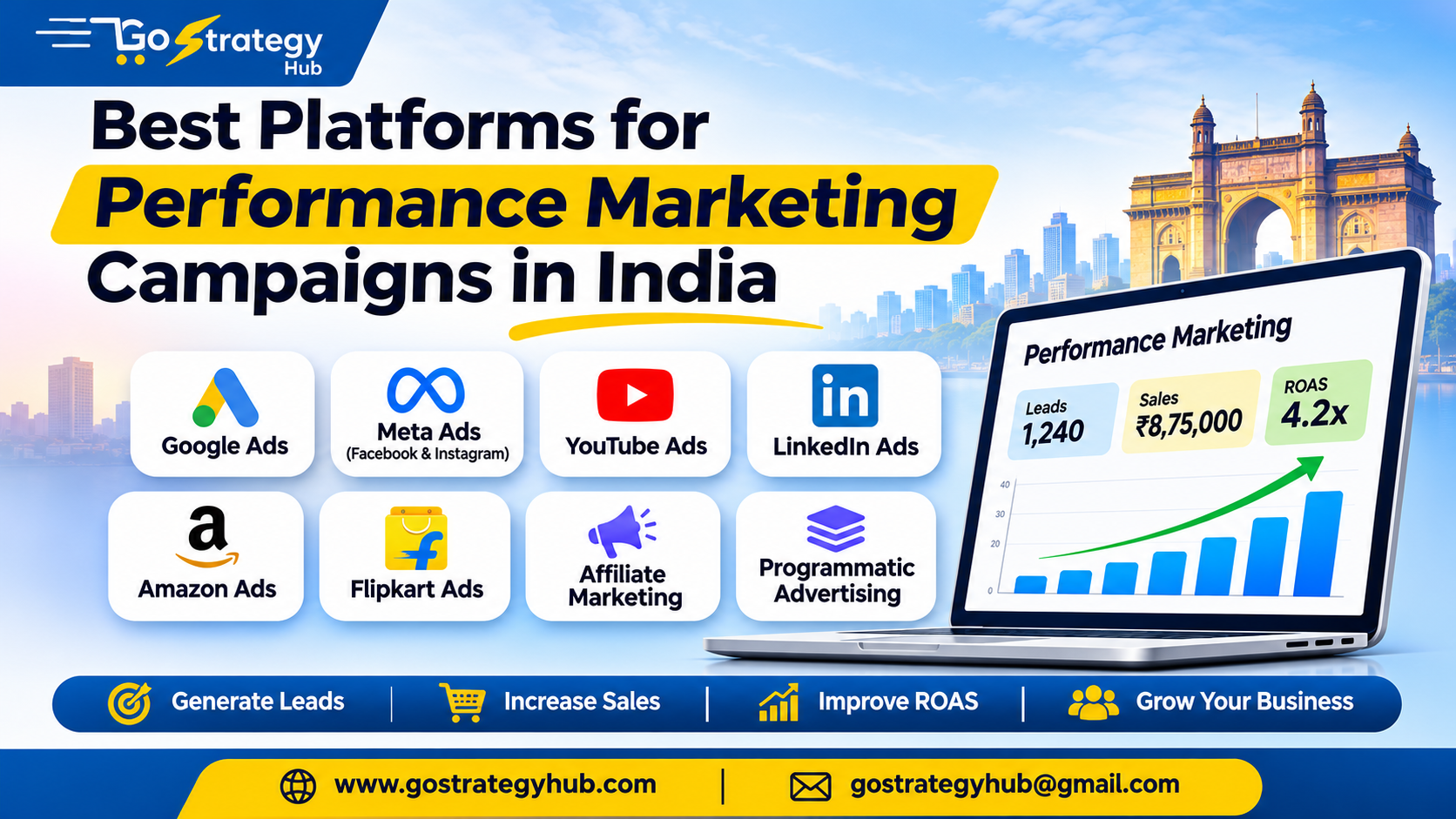
Meta Ads, Google Ads, YouTube Ads, LinkedIn Ads or Amazon Ads? Every platform has a different role in helping businesses generate leads, increase sales and grow revenue.
If you are a business owner in India and planning to invest in performance marketing, one question probably comes to mind:
Which advertising platform will give my business the best results?
The answer depends on your business model, target audience, product, budget and marketing objective.
For example, an eCommerce brand selling skincare products may get good results from Meta Ads, while a B2B company offering software services may find LinkedIn Ads and Google Search Ads more useful.
Choosing the wrong platform can waste your advertising budget, even when your product or service is good.
In this guide, we will explain the best platforms for performance marketing campaigns in India, how they work, which businesses should use them and how to choose the right platform.
What Is Performance Marketing?
Performance marketing is an advertising approach where businesses invest money to achieve measurable results.
Instead of focusing only on views, likes or impressions, businesses measure actual outcomes such as:
- Website purchases
- Qualified leads
- Phone calls
- Form submissions
- App installations
- Sales and revenue
- Return on Ad Spend (ROAS)
For example:
Suppose you spend ₹10,000 on Google Ads and generate 20 leads.
Your cost per lead is:
\[ CPL = \frac{₹10,000}{20} = ₹500 \]
This helps you understand how much you are spending to acquire each lead and whether your campaign is profitable.
Best Performance Marketing Platforms in India
Here are the platforms businesses should consider when planning performance marketing campaigns.
1. Google Ads
Google Ads is one of the best platforms for reaching customers who are already searching for a product or service.
For example, suppose someone searches:
- Best digital marketing agency in Mumbai
- Buy organic ghee online
- Best CRM software for small businesses
- Website development company in India
Google Ads allows your business to appear when potential customers search for relevant products or services.
Best Google Ads campaign types:
- Search Ads: Reach people searching for your products or services.
- Performance Max: Find customers across Google’s advertising channels using automated campaign optimisation.
- Shopping Ads: Display product images, prices and product details to online shoppers.
- Display Ads: Reach audiences through websites and apps.
- YouTube Ads: Promote your business through video advertising.
Which businesses should use Google Ads?
- Local businesses
- B2B service providers
- eCommerce brands
- Education and training institutes
- Healthcare service providers
- Real estate companies
- Software and technology companies
Example:
A Mumbai-based interior design company wants to generate enquiries from homeowners.
It can run Google Search Ads targeting searches such as “interior designer in Mumbai” and “2BHK interior design cost”.
When someone searches for these services, the company can show its advertisement and direct visitors to a landing page with a consultation form.
My recommendation: If people are already searching for your product or service, start by testing Google Search Ads.
2. Meta Ads (Facebook and Instagram Ads)
Meta Ads is one of the strongest platforms for businesses that want to reach new customers, generate leads and increase online sales.
Unlike Google Search Ads, where people actively search for something, Meta Ads helps businesses introduce their products and services to relevant audiences while they browse Facebook and Instagram.
Popular Meta Ads formats:
- Image Ads
- Video Ads
- Reels Ads
- Carousel Ads
- Collection Ads
- Lead Ads
Which businesses should use Meta Ads?
- D2C brands
- Fashion and clothing brands
- Beauty and skincare businesses
- Restaurants and food brands
- Real estate companies
- Education institutes
- Local service businesses
Example:
Suppose you sell organic ghee, honey and cold-pressed oils through your website.
You can use Meta Ads to introduce your products to potential customers through video demonstrations, product images and carousel advertisements.
A practical strategy could look like this:
- Run video ads to introduce your products.
- Show product benefits and usage through creative advertisements.
- Retarget website visitors and people who engaged with your ads.
- Run purchase-focused campaigns to generate website orders.
- Test different offers, product bundles and creatives.
My recommendation: For eCommerce and D2C businesses, Meta Ads is a strong starting point for product discovery and customer acquisition.
3. YouTube Ads
YouTube Ads is useful for businesses that want to explain their products, demonstrate services and build trust through videos.
People often need more information before purchasing something. Video advertisements help businesses explain what they offer.
Popular YouTube advertising formats:
- Skippable in-stream ads
- Non-skippable in-stream ads
- In-feed video ads
- Shorts ads
- Video reach campaigns
Which businesses should use YouTube Ads?
- Educational institutes
- Online course providers
- Real estate companies
- D2C brands
- Financial services
- Software companies
- Businesses selling products that need demonstrations
Example:
Suppose an educational institute wants to generate enquiries for its digital marketing course.
Instead of showing only a static advertisement, it can create a short video explaining:
- What students will learn
- Who should join the course
- Practical projects included
- Course duration
- How to register
The video can help potential students understand the offering before submitting an enquiry.
My recommendation: Use YouTube Ads when your product or service needs explanation, demonstration or trust-building before conversion.
4. LinkedIn Ads
LinkedIn Ads is particularly useful for B2B businesses that want to reach business owners, founders, managers and decision-makers.
The biggest advantage is professional audience targeting.
You can build audiences based on:
- Job titles
- Industries
- Company size
- Job functions
- Seniority
- Skills
- Company names
Which businesses should use LinkedIn Ads?
- SaaS companies
- IT service providers
- Consulting firms
- Recruitment agencies
- B2B software businesses
- Corporate training providers
- Business service companies
Example:
Suppose you offer CRM software for manufacturing companies.
You can create a campaign targeting operations managers, sales heads and business owners working in manufacturing companies.
Your advertisement can explain how your CRM helps manage enquiries, track sales teams and improve follow-ups.
Instead of collecting thousands of unrelated leads, your objective should be to generate enquiries from relevant decision-makers.
My recommendation: LinkedIn Ads can be useful for high-value B2B services, but lead quality and customer acquisition cost must be evaluated carefully.
5. Amazon Ads
Amazon Ads is a strong option for brands and sellers who want to increase product visibility and sales on Amazon.
People visiting Amazon are often already looking for products to purchase.
This makes marketplace advertising useful for reaching shoppers with product-related intent.
Popular Amazon Ads formats:
- Sponsored Products
- Sponsored Brands
- Sponsored Display
Which businesses should use Amazon Ads?
- Consumer product brands
- Home and kitchen brands
- Beauty and personal care brands
- Electronics sellers
- Grocery and food brands
- Private-label businesses
Example:
Suppose you sell organic honey on Amazon.
You can run Sponsored Products campaigns targeting relevant searches such as “raw honey” and “natural honey”.
Your product can appear in relevant shopping results, helping potential buyers discover it.
My recommendation: If your products are already listed on Amazon, test Amazon Ads to increase product visibility and marketplace sales.
6. Flipkart Ads
Flipkart Ads helps sellers and brands promote products to customers shopping on Flipkart.
It is particularly relevant for businesses selling products in categories such as electronics, fashion, home products and consumer goods.
Which businesses should use Flipkart Ads?
- Electronics sellers
- Fashion brands
- Home furnishing brands
- Consumer goods businesses
- Beauty and lifestyle brands
Example:
A clothing brand selling men’s shirts on Flipkart can promote its products through sponsored placements when shoppers search for relevant clothing categories.
The objective is to improve product visibility and generate more marketplace orders.
My recommendation: Consider Flipkart Ads if your business already has a presence on Flipkart and wants to grow marketplace sales.
7. Affiliate Marketing Platforms
Affiliate marketing is another performance-based channel where businesses collaborate with publishers, content creators and affiliate partners.
You generally pay a commission when a qualifying sale, lead or other agreed action takes place.
Some affiliate networks and platforms operating in India include:
- Cuelinks
- Admitad
- vCommission
Which businesses should use affiliate marketing?
- eCommerce brands
- Travel companies
- Financial service providers
- Online education businesses
- Subscription-based businesses
Example:
Suppose your online store sells skincare products.
You can partner with beauty bloggers and affiliate publishers who promote your products through their websites or content.
When a customer purchases through a tracked affiliate link, the affiliate partner earns a commission according to your agreement.
My recommendation: Affiliate marketing can help expand sales channels, but commission structure, publisher quality and attribution need proper management.
8. Programmatic Advertising
Programmatic advertising uses technology and automated bidding to purchase digital advertising space across websites, apps and other digital media.
It can help brands reach large audiences through different publishers and advertising inventory.
One example is Google Display & Video 360.
Which businesses should use programmatic advertising?
- Large eCommerce brands
- Banking and financial companies
- Automobile brands
- Large consumer brands
- Businesses running multi-channel campaigns
Example:
A national automobile brand wants to promote a new vehicle across different websites, apps and video inventory.
It can use programmatic advertising to reach relevant audiences and manage media buying across multiple advertising environments.
My recommendation: Programmatic advertising is more suitable for businesses with larger advertising budgets, advanced tracking requirements and broader audience reach objectives.
Comparison: Which Performance Marketing Platform Is Best for Your Business?
Here is a simple comparison to help you decide where to invest your advertising budget.
| Advertising platform | Best suited for | Primary objective |
|---|---|---|
| Google Ads | Local, B2B, eCommerce | Leads and sales |
| Meta Ads | D2C, eCommerce, local businesses | Leads and purchases |
| YouTube Ads | Education, D2C, services | Awareness and conversions |
| LinkedIn Ads | B2B and SaaS | Qualified B2B leads |
| Amazon Ads | Marketplace sellers | Product sales |
| Flipkart Ads | Marketplace sellers | Product sales |
| Affiliate Marketing | eCommerce and subscriptions | Sales through partners |
| Programmatic Ads | Large brands | Reach and conversions |
Remember, there is no single platform that guarantees the lowest cost per lead or highest ROAS. Results depend on your audience, competition, creative quality, offer, landing page and conversion tracking.
Which Platform Should You Choose Based on Your Business Type?
This is where most business owners get confused. They select a platform because their competitors are advertising there.
But your platform selection should start with your business model.
| Business type | Platforms to consider |
|---|---|
| D2C brands | Meta Ads, Google Ads, YouTube Ads |
| Local businesses | Google Search Ads, Meta Ads |
| B2B companies | Google Ads, LinkedIn Ads |
| Educational institutes | Google Ads, Meta Ads, YouTube Ads |
| Real estate | Google Ads, Meta Ads, YouTube Ads |
| SaaS companies | Google Ads, LinkedIn Ads |
| Amazon sellers | Amazon Ads, Meta Ads |
| Fashion brands | Meta Ads, Google Shopping, Amazon Ads |
| Restaurants | Google Ads, Meta Ads |
| Healthcare services | Google Ads, Meta Ads |
Three practical examples
Example 1: eCommerce business
Suppose you sell organic food products in India.
Your starting strategy could be:
- Meta Ads for product discovery and purchase campaigns.
- Google Shopping and Search Ads for people searching for your products.
- YouTube Ads for product demonstrations and brand trust.
- WhatsApp automation for order updates and customer communication.
Example 2: B2B service business
Suppose you provide website development and CRM services to businesses.
Your strategy could be:
- Google Search Ads to reach people searching for these services.
- LinkedIn Ads to reach founders and business decision-makers.
- Meta Ads for remarketing and additional lead generation.
- CRM automation to follow up with enquiries and track sales opportunities.
Example 3: Local service business
Suppose you run an interior design company in Mumbai.
Your strategy could be:
- Google Search Ads to capture people searching for interior designers.
- Meta Ads to showcase completed projects through images and videos.
- YouTube Ads to demonstrate your design process.
- WhatsApp follow-ups to schedule consultations.
How to Choose the Right Platform With a Limited Budget?
You do not need to advertise on all platforms from day one.
If your monthly advertising budget is ₹30,000, spreading it across six or seven platforms may not generate enough useful data to understand campaign performance.
Instead, follow this approach.
Step 1: Understand your customer
Find out who buys your product or service.
Understand their location, interests, purchasing behaviour and problems.
Step 2: Understand buying intent
Ask yourself:
Are customers already searching for my product?
If yes, Google Search Ads can be a good starting point.
Do customers need to discover my product first?
If yes, Meta Ads and YouTube Ads can help.
Are you selling to business decision-makers?
If yes, consider LinkedIn Ads and Google Search Ads.
Step 3: Select one or two primary platforms
Start with platforms that match your business objective.
Avoid spreading your budget too thin.
Step 4: Create the right advertisements
Your advertisement should explain:
- What are you selling?
- Who should buy it?
- What problem does it solve?
- Why should customers choose your business?
- What should customers do next?
Step 5: Track actual business results
Do not measure success only through clicks and impressions.
Track leads, qualified leads, purchases, revenue and customer acquisition cost.
The Most Important Part: What Happens After Someone Clicks Your Advertisement?
Many businesses believe that running advertisements is enough to generate sales.
But that is not how performance marketing works.
Imagine you spend ₹20,000 on Meta Ads and generate 100 leads.
Your CPL is ₹200.
But what happens next?
- How many leads answer your calls?
- How many are genuinely interested?
- How many receive a follow-up?
- How many become customers?
- How much revenue do those customers generate?
If you are not tracking these numbers, you cannot understand the actual performance of your campaigns.
A better performance marketing system looks like this:
Complete Performance Marketing Funnel
1. Advertising Platforms
Google Ads • Meta Ads • YouTube Ads • LinkedIn Ads
2. Website / Landing Page
Product information • Offer • Form • Purchase
3. Conversion Tracking
Google Tag • Meta Pixel • Google Tag Manager
4. Lead Management / CRM
Lead qualification • Sales follow-up • Opportunity tracking
5. Sales and Revenue
Purchases • Qualified customers • Repeat sales • Retention
This is why businesses should look beyond advertising platforms.
Your advertising strategy, creative strategy, landing page, tracking and follow-up process should work together.
Important Performance Marketing Metrics You Should Track
Before increasing your advertising budget, understand these important metrics.
| Metric | What it tells you |
|---|---|
| CTR | How many people click your advertisement |
| CPC | How much you pay per click |
| CPL | How much you pay per lead |
| CPA | How much you pay to acquire a customer |
| Conversion Rate | How many visitors complete the desired action |
| ROAS | Revenue generated compared to advertising spend |
| Customer Acquisition Cost | Total cost of acquiring a customer |
For example:
Suppose your eCommerce business spends ₹20,000 on advertising and generates ₹80,000 in tracked sales.
\[ ROAS = \frac{₹80,000}{₹20,000} = 4 \]
Your ROAS is 4x.
However, remember that ROAS is not the same as profit. You must also consider product costs, shipping, taxes, discounts and other business expenses.
Final Thoughts
Choosing the best performance marketing platform in India is not about selecting the most popular advertising channel.
It is about understanding your customer and finding where your business can generate profitable results.
If you run an eCommerce business, start by evaluating Meta Ads and Google Ads.
If you provide B2B services, consider Google Search Ads and LinkedIn Ads.
If your product needs demonstrations and explanation, YouTube Ads can be useful.
If you sell products through marketplaces, consider Amazon Ads and Flipkart Ads.
Most importantly, do not increase your advertising budget just because you are getting more clicks or leads. First understand whether those clicks and leads are generating actual revenue.
A successful performance marketing campaign is not just about spending money on advertisements. It is about building a complete system that turns advertising investment into business growth.
Looking for Performance Marketing Services in Mumbai?
At GoStrategyHub, we help businesses build performance marketing strategies beyond just Facebook and Google Ads.
Our approach focuses on the complete customer journey:
- Google Ads and Meta Ads campaign management
- YouTube advertising strategy
- Creative and audience strategy
- Landing page optimisation
- Conversion tracking and reporting
- Lead generation and CRM automation
- WhatsApp, SMS and email follow-ups
- Customer retention and repeat sales
If you are looking for a performance marketing agency in Mumbai, visit GoStrategyHub to understand how a complete advertising and conversion system can help grow your business.
