

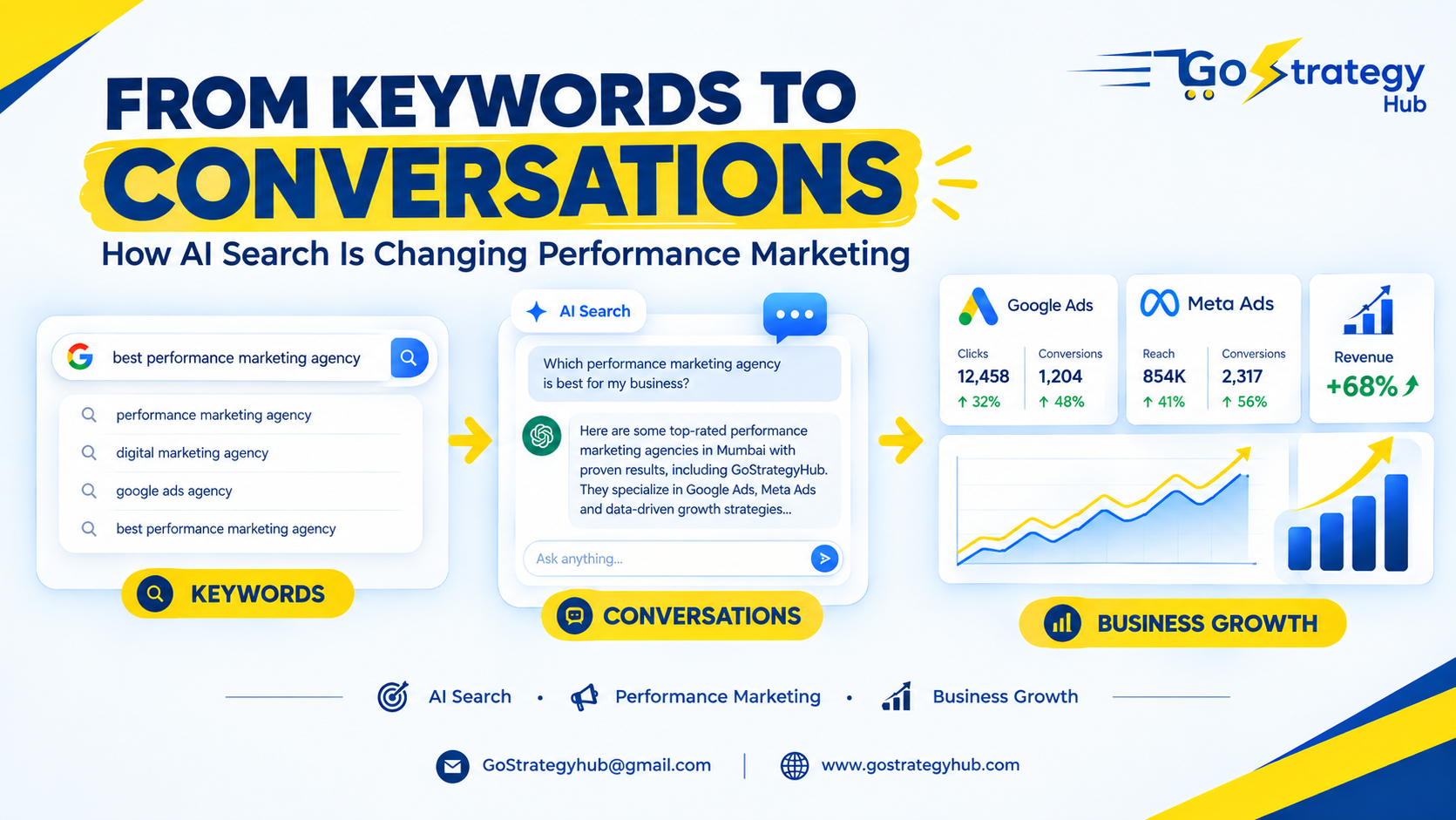
For years, performance marketing was built around keywords.
A customer searched for “performance marketing agency in Mumbai,” clicked an ad or website, compared a few options, and eventually made a decision.
AI search is changing that journey.
Today, users are increasingly asking complete questions such as:
“Which performance marketing agency in Mumbai can help my business generate qualified leads?”
Or:
“How should I choose the right agency for Google Ads and Meta Ads?”
Instead of simply matching keywords, AI search engines try to understand the context, intent, entities, relationships, and meaning behind the question.
For business owners, this creates a major shift in how marketing visibility and customer acquisition should be approached.
From Search Queries to Conversations
Traditional search often starts with a keyword.
AI search starts with a question or conversation.
A potential customer may not search for exactly the keyword you are targeting. They may describe their business problem, budget, industry, customer type, or desired outcome.
For example, instead of:
“Google Ads agency Mumbai”
a business owner might ask:
“Why are my Google Ads generating leads but very few customers?”
This means businesses need content that answers the real questions customers are asking, not just pages created around individual keywords.
What Does This Mean for Performance Marketing?
Performance marketing has always focused on measurable outcomes such as leads, sales, conversions and revenue.
AI search adds another layer: being understood and surfaced when customers ask questions related to your business.
A modern performance marketing agency therefore needs to think beyond ad campaigns.
It needs to understand:
- What problems customers are trying to solve
- What questions they ask before purchasing
- What information influences their decision
- Which services, brands and businesses are mentioned together
- How AI systems understand a company’s expertise
- Whether website content clearly explains the company’s services and experience
This connects performance marketing with AI SEO, AEO, content strategy and brand authority.
Why Business Owners Should Care About AI Search
Imagine a business owner asks an AI search engine:
“What should I look for before hiring a performance marketing agency?”
The answer may mention factors such as:
- Google Ads experience
- Meta Ads expertise
- Conversion tracking
- Lead quality
- CRM integration
- Landing page optimization
- ROI measurement
- Industry experience
- Case studies
- Business growth strategy
If your website clearly demonstrates these areas, your brand has more relevant information for AI systems to understand.
This doesn’t mean simply adding more keywords.
It means building useful, structured and trustworthy information around the questions your potential customers actually ask.
Keywords Still Matter, But They Are Not Enough
Keywords have not disappeared.
They still help search engines understand topics and page relevance.
But businesses should avoid creating content that repeatedly inserts phrases such as “best performance marketing agency in Mumbai” without providing meaningful information.
Instead, build topic depth around the underlying intent.
For example, a page targeting best performance marketing agency in Mumbai could also answer:
- What does a performance marketing agency do?
- How does performance marketing generate measurable growth?
- Should a business use Google Ads or Meta Ads?
- How is lead quality measured?
- What should businesses track beyond CPL?
- How does conversion tracking affect campaign performance?
- How can an agency connect advertising data with actual revenue?
This creates a stronger resource for both humans and AI search systems.
AI Search Is Making Business Questions More Specific
The biggest change isn’t simply that people are using AI.
It is that their questions are becoming more detailed.
A business owner can now ask:
“I run a B2B company and my Meta Ads are generating leads, but sales says most leads aren’t qualified. What should I change?”
That question contains multiple signals:
Business type → platform → problem → lead quality → desired solution
A strong marketing strategy needs to address these signals together.
This is why generic content can struggle to stand out while specific, experience-based content can become more useful.
What Should a Business Owner Do?
If you want your business to remain visible across traditional search and AI-powered search, start with these fundamentals.
1. Create content around customer questions
Don’t only ask:
“What keywords should we target?”
Also ask:
“What questions does our ideal customer ask before buying?”
Turn those questions into useful website pages, blogs, FAQs and service content.
2. Demonstrate real expertise
AI-friendly content should still be human-friendly.
Explain your processes, observations, examples, results and lessons.
Generic statements like “we deliver exceptional marketing solutions” provide little useful information.
Specific explanations are much more valuable.
3. Build topical authority
Don’t publish one article about Google Ads and stop.
Build connected content around:
Google Ads → conversion tracking → landing pages → lead quality → CRM → offline conversions → ROI
The same approach can be applied to Meta Ads, SEO, AEO and other marketing topics.
4. Make your website easy to understand
Your website should clearly communicate:
- Who you serve
- What services you provide
- What problems you solve
- How your process works
- What results you measure
- Why businesses work with you
Clear information helps potential customers and search systems understand your business.
5. Optimize for qualified outcomes
AI search may change how people discover your company, but business fundamentals haven’t changed.
Traffic isn’t the final goal.
Neither are impressions or clicks.
Businesses ultimately care about qualified leads, customers, revenue and ROI.
That means performance marketing strategies should connect advertising data with actual business outcomes wherever possible.
The Future of Performance Marketing Is Conversational
The shift from keywords to conversations doesn’t mean SEO is dead.
It means search is becoming more intent-driven and contextual.
A business owner may discover your brand through a traditional Google search, an AI-generated answer, a recommendation, a citation, a social post or a detailed question about a specific business problem.
The brands that prepare for this shift won’t focus only on ranking for individual keywords.
They will build an ecosystem of useful content, clear entities, strong brand information, measurable advertising and genuine expertise.
That is where performance marketing and AI SEO increasingly intersect.
Final Takeaway
The question is no longer only:
“What keyword should my business rank for?”
The better question is:
“What questions should my business be the answer to?”
For business owners, this is the real opportunity in AI search.
Build content around customer problems.
Answer specific questions.
Demonstrate expertise.
Connect marketing activity with business results.
Because as search moves from keywords to conversations, performance marketing needs to evolve with it.
GoStrategyHub helps businesses approach performance marketing with a focus on measurable growth, qualified leads, conversions and ROI.
Frequently asked questions
What is AI search in performance marketing?
AI search uses artificial intelligence to understand conversational questions and provide contextual answers. For performance marketing, this means businesses need to consider customer intent and questions alongside traditional keyword targeting.
How can businesses optimize for AI search?
Businesses can create useful question-focused content, demonstrate expertise, build topical authority, maintain clear website information and provide structured, trustworthy information.
Why is performance marketing important for business growth?
Performance marketing connects marketing activity with measurable outcomes such as leads, sales, conversions and ROI, allowing businesses to evaluate marketing based on business results.