

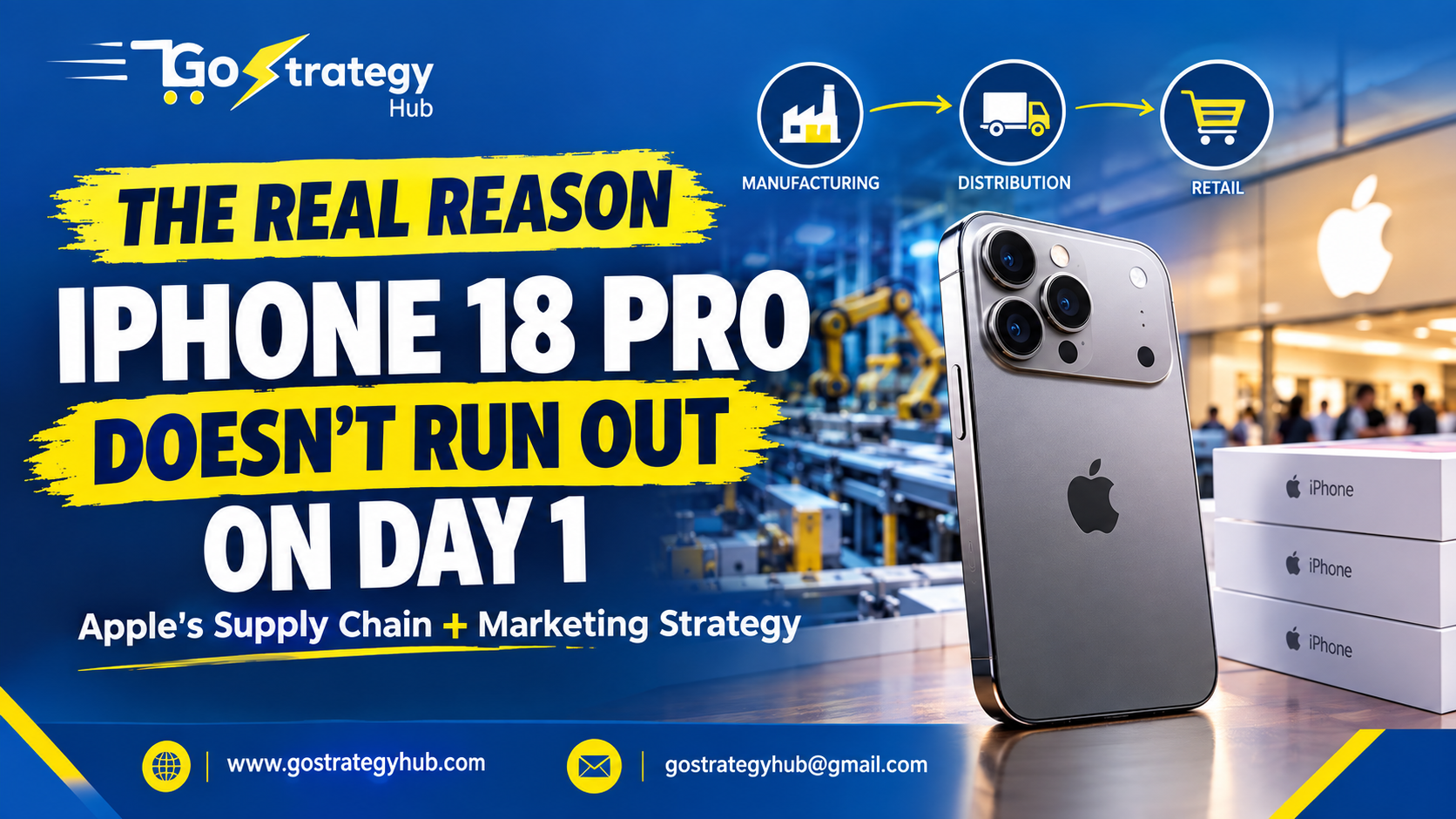
When a new iPhone launches, millions of people want it immediately.
But here is the interesting part:
How does Apple prepare enough inventory for a global launch without creating massive excess stock?
The answer is not simply better advertising.
It is a combination of supply chain planning, manufacturing capacity, component control, global distribution and demand forecasting.
The launch of the iPhone 18 Pro and iPhone 18 Pro Max in September 2026 provides a useful example.
The iPhone Launch Is a Supply Chain Operation
Apple’s latest Pro models became available on September 18, 2026, after pre-orders began earlier in the month. Apple also expanded manufacturing in India, with Foxconn and Tata Electronics producing the new Pro models for global markets.
Reports ahead of launch showed Indian manufacturing facilities operating around the clock and shipping devices to international markets ahead of launch day.
That means the launch is not something Apple starts preparing a few weeks before September.
It requires months of planning.
1. Apple Uses a Global Manufacturing Network
Apple’s supply chain includes thousands of supplier facilities across more than 60 countries.
Suppliers manufacture parts and components, which are then assembled into finished Apple products before being packaged and shipped globally.
For the iPhone 18 Pro generation, India has become increasingly important.
Foxconn and Tata Electronics are manufacturing Pro models in India, with production supporting both the Indian market and international markets.
This gives Apple additional manufacturing capacity and helps diversify where iPhones are assembled.
2. Apple Controls Critical Technology
Apple does not manufacture every component inside an iPhone itself.
Instead, it combines its own product and silicon design with a huge network of specialized suppliers.
The iPhone 18 Pro uses Apple’s A20 Pro chip, while other components come from Apple’s global supplier ecosystem. Apple has also continued investing in custom silicon and other critical technologies.
This distinction matters.
Apple’s advantage is not simply “making everything itself.”
It is coordinating a complex ecosystem around a tightly controlled product.
3. Production Starts Before the Launch
One reason consumers can buy a new iPhone immediately after launch is that production ramps up before customers can purchase the device.
For the iPhone 18 Pro and Pro Max, Indian factories were reportedly running around the clock before launch, with finished phones shipped internationally ahead of the sales date.
This is a classic supply chain principle:
Forecast demand → secure components → ramp production → position inventory → launch simultaneously.
Marketing creates demand.
Operations make sure the business can fulfill it.
4. Apple Is Bringing the iPhone Closer to the Customer
The interesting part of the 2026 launch is not only manufacturing.
It is distribution.
In India, consumers could buy the new iPhone through Apple’s own channels, authorized retailers, online marketplaces and quick-commerce platforms.
Platforms such as Blinkit, Zepto, Swiggy Instamart and BigBasket offered the new Pro models with delivery that could take around 10 minutes in some locations.
Think about how unusual that is.
A premium smartphone costing more than ₹1 lakh can potentially arrive through the same type of app people use for groceries.
That changes the meaning of convenience.
5. Marketing and Operations Have to Work Together
This is where performance marketing becomes interesting.
Imagine spending millions creating demand for a product that your supply chain cannot deliver.
You can generate clicks.
You can generate leads.
You can create massive awareness.
But if the customer cannot buy the product, the marketing system eventually breaks.
Apple’s launch demonstrates an important business principle:
Demand generation and demand fulfillment must work together.
This is also relevant for founders working with a performance marketing agency.
Performance marketing services should not only focus on metrics such as CPC, CPL or ROAS.
The bigger question is:
Can the business actually handle the demand being created?
The Real Apple Strategy
The iPhone launch looks like a marketing event.
But underneath the launch is a much larger operational system.
Apple coordinates product design, suppliers, manufacturing, logistics, retail and digital distribution to make a global launch possible.
And the 2026 iPhone 18 Pro launch shows how that system is evolving.
India is becoming an important manufacturing base, while quick-commerce platforms are becoming another route for premium electronics to reach customers.
For founders, the bigger lesson is simple:
Marketing can create demand.
Operations determine whether you can capture it.
That is why the best performance marketing strategy is not just about getting more clicks.
It is about building a system where demand can turn into revenue.
If you’re looking for performance marketing services focused on measurable business growth, explore GoStrategyHub.
About the Author
Preeti is a performance marketer and founder at GoStrategyHub, a performance marketing agency with 10+ years of experience helping businesses drive measurable growth. She provides performance marketing services across Google Ads, Meta Ads, lead generation and conversion-focused campaigns.