

Meta advertising is becoming more intelligent. But the biggest change is not simply the addition of AI features. It is how artificial intelligence understands advertisements, identifies relevant users and predicts which ads are more likely to generate results.
On October 28, 2026, Meta announced three important developments in its advertising technology: Andromeda, GEM and GenRecs.
These innovations are improving how Meta selects advertisements, learns from user behaviour and understands creative content.
For advertisers, this means the traditional approach to Facebook and Instagram advertising needs to evolve.
Instead of focusing only on audience targeting, marketers need to pay more attention to creative strategy, conversion tracking, campaign objectives and the quality of data they provide to Meta.
Let’s understand what these three AI innovations actually do and how they affect your advertising strategy.
Table of Contents
- What Is Meta Ads 2.0?
- What Is Meta Andromeda?
- What Is Meta GEM AI?
- What Is Meta GenRecs?
- How Do These Three AI Systems Work Together?
- What Do These Updates Mean for Advertisers?
- How to Optimize Your Meta Ads Strategy in 2026
- Frequently Asked Questions
1. What Is Meta Ads 2.0?
Meta Ads 2.0 is a useful way to describe the latest evolution of Meta’s AI-powered advertising systems.
Meta is improving the technology behind ad retrieval, recommendations, creative understanding and ranking.
Previously, advertisers spent considerable time manually testing audiences, adjusting targeting options and optimizing campaign settings.
Those activities still matter, but AI now plays a much bigger role in deciding which advertisements should be considered and delivered to different users.
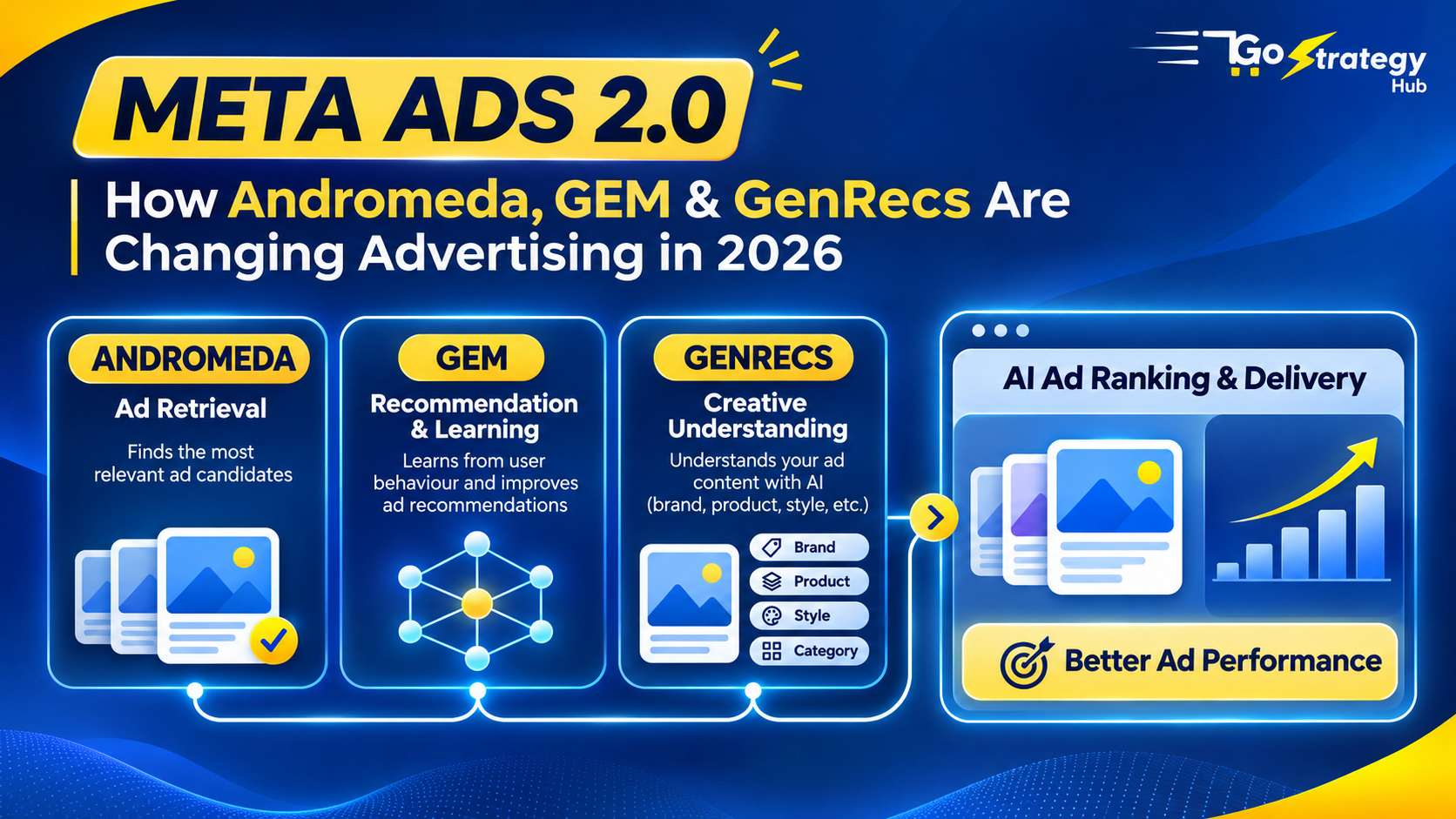
Meta’s latest developments focus on three important areas:
- Andromeda: Finds relevant advertisements from a huge pool of eligible ads.
- GEM: Learns from user behaviour and improves ad recommendations.
- GenRecs: Understands the meaning and attributes of advertisements through AI.
Together, these systems help Meta improve the process of matching advertisements with potential customers.
2. What Is Meta Andromeda? AI-Powered Ad Retrieval
Meta Andromeda is an advertising retrieval engine.
Before an advertisement is displayed, Meta needs to identify which ads are relevant enough to be considered for a particular user.
Imagine millions of advertisements competing for attention. Meta cannot run every advertisement through the complete ranking process for every impression.
This is where Andromeda comes in.
It helps narrow down a massive collection of eligible advertisements into a smaller group of relevant candidates.
What’s new in Andromeda?
According to Meta’s October 2026 announcement, the next generation of Andromeda uses specialized expert models rather than relying on one general model for everything.
This allows the retrieval system to evaluate advertisements with more specialized capabilities.
Meta also highlighted a new throughput benchmark of more than one billion ads per second at the retrieval stage.
What does this mean for advertisers?
Consider an ecommerce brand selling skincare products.
It might have different advertisements focusing on:
- Acne and skincare problems
- Product ingredients
- Customer testimonials
- Product demonstrations
- Discounts and product bundles
These creatives communicate different messages.
Andromeda’s improved retrieval capabilities help the system consider a broader range of eligible ads and identify more relevant candidates.
Practical takeaway: Don’t create multiple versions of the same advertisement just to increase creative volume. Develop different creative angles that communicate different customer needs and product benefits.
3. What Is Meta GEM AI? Improving Ad Recommendations
GEM stands for Generative Ads Recommendation Model.
It is one of Meta’s important AI developments for understanding user behaviour and improving advertising recommendations.
GEM was introduced in March 2025. In its October 2026 announcement, Meta explained how it has expanded its role across Facebook, Instagram, Reels and off-Meta conversions.
How does GEM work?
GEM learns from large amounts of advertising engagement information.
It uses these learnings to help train and improve specialized ranking models that make real-time advertising decisions.
For example, users may interact with advertisements in different ways:
- Watching a video advertisement.
- Clicking on a product.
- Visiting an ecommerce website.
- Adding products to their cart.
- Completing a purchase.
These interactions provide valuable signals about user interests and behaviour.
GEM helps transfer broader learnings to the models responsible for advertising recommendations.
This is particularly interesting for advertisers optimizing for deeper-funnel actions, where individual campaigns may have relatively limited conversion data.
Why should advertisers care?
Many businesses struggle when their campaigns generate clicks but very few purchases or qualified leads.
Better recommendation systems can help improve how Meta uses available learning signals.
However, advertisers should not assume that AI can automatically fix poor conversion tracking or an unclear campaign objective.
The quality of the information being shared with Meta still matters.
4. What Is Meta GenRecs? AI That Understands Your Ad Creatives
GenRecs, short for Meta Generative Recommender, introduces another important development.
Traditional recommendation systems rely heavily on patterns in user interactions.
But what happens when an advertisement is completely new?
It may not have enough clicks, impressions or conversion history for traditional behavioural signals to provide strong guidance.
GenRecs addresses this challenge by helping AI understand the actual content of advertisements.
What is GenRecs Tokenization?
GenRecs Tokenization uses language models to interpret advertisement images and text.
It identifies meaningful attributes such as:
- Brand
- Product category
- Colour
- Style
- Fit
These attributes are converted into semantic tokens.
Think of semantic tokens as descriptive labels that help AI understand what an advertisement represents.
For example, imagine an ecommerce brand launching a new pair of running shoes.
The advertisement contains information about the brand, product category, colour and style.
GenRecs can help represent these attributes in a shared vocabulary.
The system can then relate this new advertisement to similar products and advertisements it already understands.
Why is this important?
New advertisements often have limited engagement history.
Instead of relying only on historical clicks and conversions, AI can also use its understanding of the creative content.
For advertisers, this makes creative communication even more important.
Your advertisement should clearly communicate:
- What are you selling?
- Who is the product for?
- What problem does it solve?
- What makes it different?
- Why should someone consider buying it?
The clearer your creative message, the easier it is for people to understand your offer and for AI systems to interpret the content.
5. How Do Andromeda, GEM and GenRecs Work Together?
These three innovations address different parts of Meta’s advertising recommendation process.
| AI Technology | Primary Role |
|---|---|
| GenRecs | Understands ad content and creates semantic representations |
| Andromeda | Retrieves relevant ad candidates |
| GEM | Learns from engagement patterns and improves recommendations |
| Ranking models | Evaluate and rank candidate advertisements |
Let’s simplify the complete process.
Step 1: Creative Understanding
GenRecs helps Meta understand the content of your advertisements.
Step 2: Ad Retrieval
Andromeda identifies relevant advertisements from the available pool.
Step 3: Recommendation Learning
GEM transfers broader learning to specialized recommendation models.
Step 4: Ad Ranking
Ranking models evaluate the shortlisted advertisements and help determine which ones should be displayed.
Step 5: Ad Delivery
Meta delivers advertisements based on its predictions and the opportunities available across its platforms.
The important point is that advertisers do not need to activate these technologies individually. Meta says these improvements are applied automatically within its advertising systems.
6. What Do These Updates Mean for Advertisers?
These developments change how performance marketers should approach campaign optimization.
Here are five important implications.
1. Creative Strategy Is Becoming More Important
Audience targeting is no longer the only major consideration.
Advertisers need to develop different creative concepts, hooks, product demonstrations and messaging angles.
For example, a skincare brand can test:
- Problem-focused creatives.
- Ingredient-focused creatives.
- Customer testimonials.
- Before-and-after demonstrations, where appropriate and compliant.
- Product comparison creatives.
The objective is to give the system genuinely different messages to evaluate.
2. Creative Quantity Is Not the Same as Creative Quality
Uploading 20 similar advertisements does not automatically create a strong creative strategy.
What matters is meaningful variation.
Test different customer motivations, objections, product benefits and offers.
3. Conversion Tracking Still Matters
AI optimization depends on the signals available to the advertising system.
If your purchase events are inaccurate or your lead events do not represent genuine business enquiries, optimization decisions can become less useful.
Review your:
- Meta Pixel implementation.
- Conversion event configuration.
- Purchase and lead event accuracy.
- Event deduplication.
- Meta Conversions API, where applicable.
- Website and CRM conversion data.
Better measurement helps you understand whether advertising is generating actual business outcomes.
4. Don’t Overcomplicate Audience Targeting
Advertisers should avoid making unnecessary audience restrictions simply because they want complete manual control.
Use audience targeting strategically, but give the delivery system enough room to identify relevant users when your campaign objective and business requirements allow it.
5. Optimize for Business Outcomes, Not Just Clicks
A campaign generating inexpensive clicks is not necessarily a profitable campaign.
For lead generation, evaluate qualified leads, sales opportunities and closed revenue.
For ecommerce, evaluate purchases, customer acquisition cost, average order value and return on ad spend.
The objective should reflect what actually creates value for your business.
7. How to Optimize Your Meta Ads Strategy in 2026
Based on these developments, here is a practical framework advertisers can follow.
| Area | What Advertisers Should Do |
|---|---|
| Creative Strategy | Test different hooks, formats and product benefits |
| Audience Strategy | Avoid unnecessary targeting restrictions |
| Campaign Objective | Select the outcome that matches your business goal |
| Conversion Tracking | Maintain accurate Pixel and conversion event data |
| Landing Page | Improve message consistency and conversion experience |
| Lead Quality | Connect CRM and sales feedback where possible |
| Optimization | Evaluate revenue, purchases and qualified leads |
Remember, better AI does not mean that every campaign will automatically become profitable.
Your offer, pricing, landing page, product demand, customer experience and conversion measurement still influence business results.
8. Frequently Asked Questions
What are Meta Andromeda, GEM and GenRecs?
They are three AI innovations within Meta’s advertising recommendation systems. Andromeda improves ad retrieval, GEM improves recommendation learning, and GenRecs helps AI understand advertisement content.
Does Meta Andromeda replace audience targeting?
No. Andromeda is an ad retrieval system, not an audience targeting replacement. Advertisers still need to select appropriate campaign objectives, audience settings and delivery strategies.
What is the difference between GEM and GenRecs?
GEM is a recommendation model that learns from advertising engagement patterns and transfers knowledge to ranking models. GenRecs focuses on understanding advertisement content and user preferences through semantic representations and generative recommendation.
Do advertisers need to activate Andromeda, GEM or GenRecs?
No. According to Meta, these improvements are integrated into its advertising delivery systems automatically. Advertisers do not need to activate separate settings or create a new campaign type.
Will AI reduce the importance of creative testing?
No. Creative testing remains important. In fact, better creative understanding and retrieval make it more valuable to develop meaningful creative variations instead of relying on repetitive advertisements.
How can businesses improve Meta Ads performance in 2026?
Businesses should focus on creative diversity, strong offers, accurate conversion tracking, relevant landing pages and optimization towards meaningful business outcomes.
Final Thoughts: The Future of Meta Ads Is About Better Inputs
Meta’s latest AI developments show that advertising systems are becoming better at understanding creative content, identifying relevant advertisements and predicting user behaviour.
But there is one important thing advertisers should remember.
AI cannot turn an unclear offer into a compelling one. It cannot fix a poor landing page or make inaccurate conversion data reliable.
Technology can improve how advertisements are selected and delivered, but business strategy still determines what makes an advertisement worth showing.
At GoStrategyHub, we believe performance marketing goes beyond running Facebook and Google Ads. It requires a complete system connecting advertising, creative strategy, landing pages, conversion tracking, CRM and customer retention.
The algorithm is getting better at finding the customer. Your job is to give it something worth showing.
If you want to improve your advertising strategy and generate better leads or purchases, explore our performance marketing services.
