

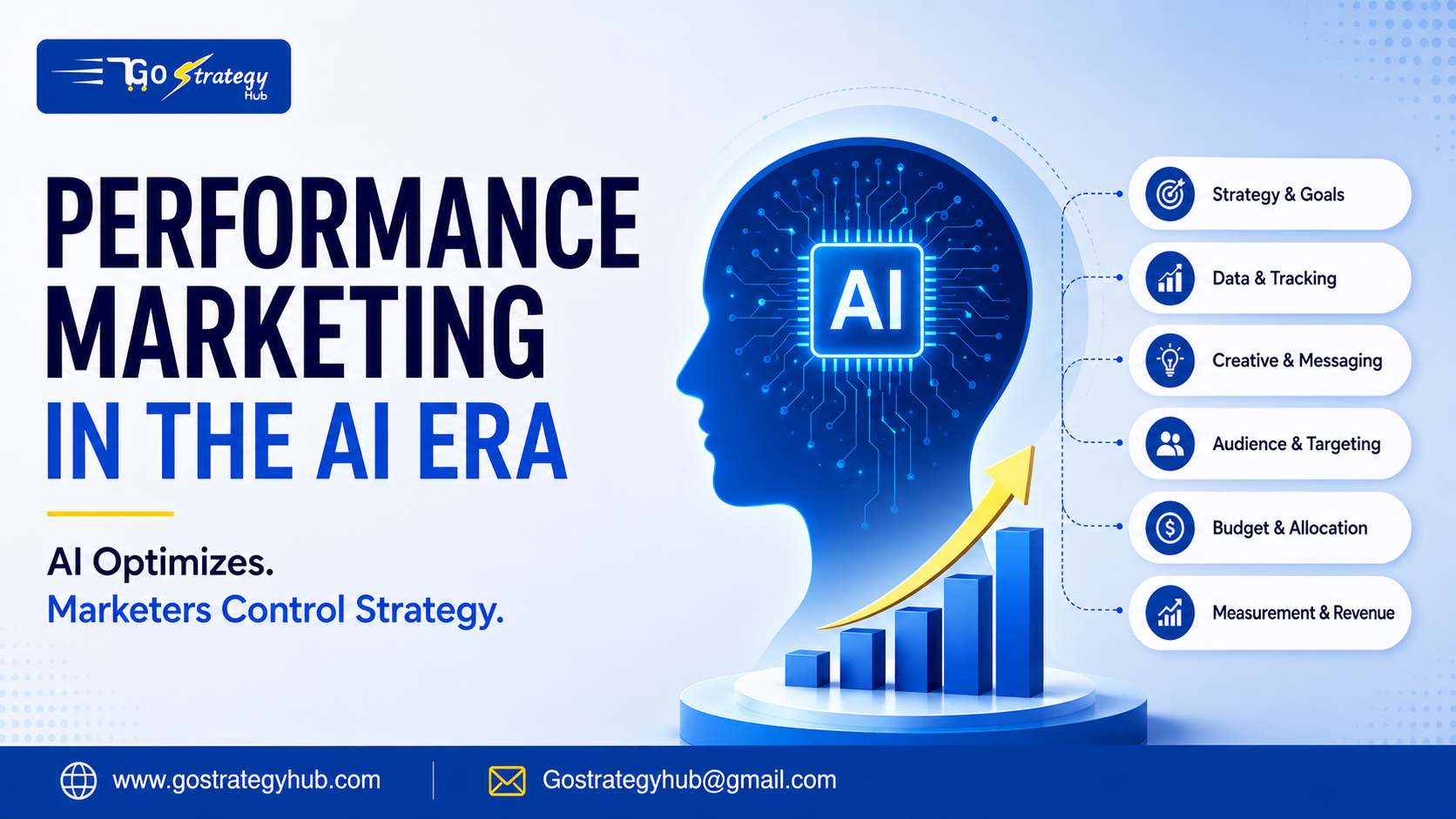
Performance marketing is entering a new phase.
AI can now help with bidding, audience discovery, campaign optimization, creative generation, reporting and performance insights. Google, for example, is expanding AI capabilities across Google Ads and Google Analytics, while AI powered bidding can automatically optimize bids based on conversions or conversion value.
But this does not mean marketers are becoming less important.
It means their role is changing.
Modern performance marketing is no longer about manually adjusting every bid, keyword or audience. Instead, marketers need to provide the right strategy, business goals, data, creative direction and measurement signals so AI can optimize toward meaningful outcomes.
AI has become deeply integrated into paid advertising platforms.
On Google, automated bidding uses AI to set bids for individual auctions based on the likelihood of achieving conversions or conversion value.
AI is also being used to support campaign insights, creative development and optimization. Google’s 2026 updates include AI tools designed to help marketers identify opportunities, generate reports and take actions faster.
This changes the day to day role of a performance marketer.
Instead of asking:
“What bid should I set?”
The better question is:
“What should the algorithm optimize for?”
That shift is at the heart of modern performance marketing.
1. Marketers Still Need to Control the Strategy
AI can optimize toward a goal, but it does not automatically know the complete business strategy.
A campaign may generate leads at a low cost, but those leads may have poor quality.
An ecommerce campaign may generate a strong ROAS, but margins may be too low.
A brand may generate conversions while attracting customers with low lifetime value.
The marketer needs to define what success actually means.
That includes decisions around:
- Business objectives
- Target customers
- Offers
- Budget allocation
- Profitability
- Customer lifetime value
- Growth targets
- Brand positioning
- Short term versus long term goals
AI can optimize the system. Humans still need to decide where the system should go.
AI is only as good as the signals it receives.
If Google Ads is being told that every form submission is a valuable conversion, the algorithm can optimize toward more form submissions.
But more forms do not necessarily mean more customers.
Modern performance marketing should connect advertising with the actual customer journey.
For example:
100 Leads → 30 Qualified Leads → 10 Sales → ₹X Revenue
This is much more useful than simply reporting:
100 Leads → ₹500 Cost Per Lead
Google itself recommends using meaningful conversion goals and supports qualified and converted lead measurement to help bridge the gap between online leads and actual business outcomes.
This is one of the most important areas marketers still need to control.
As privacy changes make traditional tracking more difficult, businesses need stronger first party data strategies.
Customer information, CRM data, purchase history, qualified leads and offline sales can help create better measurement signals.
Google’s Enhanced Conversions, for example, uses hashed first party customer data to improve conversion measurement and can provide stronger signals for AI powered optimization.
The marketer’s responsibility is not simply to collect more data.
It is to identify which data actually represents business value and connect that information to advertising platforms correctly.
AI can generate multiple headlines, images, videos and variations quickly.
But creating more content does not automatically create better advertising.
A strong creative strategy still requires understanding:
- Customer pain points
- Buying motivations
- Objections
- Product differentiation
- Market positioning
- Offers
- Brand voice
- Emotional triggers
AI can help marketers produce and test more variations. Human marketers need to decide what ideas are worth testing in the first place.
In an AI driven advertising environment, creative strategy can become an even bigger competitive advantage because platforms can use large amounts of creative and performance data to determine what works.
Sometimes the problem is not the campaign.
It is the offer.
AI can optimize an advertisement for clicks or conversions, but it cannot magically turn an unattractive offer into a compelling one.
For example, changing:
“Get in Touch With Us”
to a more specific and valuable offer may have a bigger impact than changing the campaign settings.
Marketers still need to ask:
Why should someone choose this product or service today?
The answer influences the ad, landing page, sales process and ultimately the conversion rate.
AI can identify patterns quickly, but marketers still need to question whether those patterns represent genuine business growth.
A platform may report:
- Lower CPA
- Higher conversion volume
- Better ROAS
- More clicks
But the business should also ask:
- Are customers profitable?
- Are leads qualified?
- Did revenue increase?
- Did customer quality improve?
- Are we acquiring incremental customers?
- Is performance sustainable?
Measurement therefore becomes more important, not less.
Google’s current measurement tools increasingly combine conversion data, modeling and AI to help advertisers understand performance, but marketers still need to define the business metrics that matter.
AI can help optimize budgets within campaigns, but marketers still have to make broader investment decisions.
Should the business spend more on Google Ads?
Should Meta receive a larger share?
Should the brand invest in YouTube?
Should some budget move toward remarketing?
Should the company focus on acquisition or retention?
These decisions involve market conditions, margins, sales capacity and business priorities.
AI can provide recommendations and predictions, but budget decisions should remain connected to the overall business strategy.
Traditional performance marketing often involved manually changing:
Keywords → Bids → Audiences → Budgets
AI is increasingly taking over many of these operational tasks.
The marketer’s role is moving toward:
Strategy → Data → Creative → Measurement → Business Decisions
Google’s own guidance on steering AI powered search emphasizes that advertisers can adjust targets, budgets and campaign inputs based on changing business needs.
This means marketers are not losing control.
They are moving to a higher level of control.
AI should not replace marketing strategy.
It should strengthen it.
A modern performance marketing agency should know how to combine platform automation with human expertise.
That means understanding:
Business Goal → Strategy → Tracking → Data → Creative → AI Optimization → CRM → Revenue
The strongest approach is not “AI versus marketers.”
It is:
AI for scale + Human expertise for direction.
For businesses looking for a best performance marketing agency in Mumbai, this distinction matters. The value of an agency is increasingly determined by how well it can connect advertising technology with business objectives, accurate measurement and revenue outcomes.
10. What Marketers Should Control in the AI Era
AI may handle more campaign execution, but marketers should continue controlling these areas:
Strategy
Define what the business actually wants to achieve.
Conversion Signals
Tell advertising platforms which actions represent real value.
Data Quality
Make sure the information being sent to platforms is accurate and useful.
Creative Direction
Develop strong concepts, offers, messages and customer angles.
Budget Strategy
Decide where investment should go based on business priorities.
Measurement
Look beyond platform metrics and connect campaigns with CRM and revenue.
Customer Quality
Optimize for valuable customers rather than simply cheap conversions.
Business Context
Consider margins, sales capacity, seasonality, inventory and customer lifetime value.
The Future of Performance Marketing Is Human + AI
AI is changing how performance marketing works, but it is not removing the need for marketers.
The biggest change is that marketers are moving away from repetitive campaign management and toward strategic decision making.
AI can process enormous amounts of data, automate optimization and produce creative variations at speed.
Humans still need to decide:
What should we optimize for?
Who should we target?
What should we say?
What is a valuable customer?
How much should we spend?
What does profitable growth actually mean?
That is why the future of performance marketing is not about choosing between AI and human expertise.
It is about building a system where AI handles complexity and speed, while marketers control strategy, data quality, creative direction, measurement and business outcomes.
For brands working with a performance marketing agency, this shift creates a new standard: the goal is no longer simply to manage advertising platforms. The goal is to build an intelligent marketing system that turns better signals, better strategy and better execution into measurable business growth.