

Artificial intelligence is changing how businesses plan, launch, optimize, and measure advertising campaigns. Automated bidding, algorithmic targeting, AI generated creative variations, predictive insights, and automated recommendations are becoming increasingly common.
But the biggest change in performance marketing in 2026 is not simply that AI is doing more work.
It is that the quality of the inputs and business signals now matters more than the amount of manual control a marketer has.
The question is no longer whether AI can run advertising campaigns. The more important question is whether businesses are giving AI the right signals to make better decisions.
What Is Performance Marketing in 2026?
Performance marketing is a measurable approach to digital marketing where campaigns are connected to business outcomes such as leads, sales, qualified opportunities, customers, or revenue.
In 2026, platforms such as Google Ads and Meta Ads rely heavily on machine learning and automation. Marketers provide objectives, budgets, creative assets, conversion signals, and audience information while algorithms increasingly influence campaign delivery and optimization.
This means marketers have less need to manually control every campaign setting.
Instead, they need to focus more on strategy, customer understanding, creative direction, measurement, and business outcomes.
A technically optimized campaign can still produce poor results if the offer is weak, tracking is inaccurate, leads are poorly qualified, or the sales process cannot convert the demand generated by advertising.
What AI Is Changing in Performance Marketing
1. Campaign Optimization Is More Automated
AI can process large volumes of data across bidding, placements, audiences, search behaviour, and conversions.
Automated bidding and optimization reduce manual campaign management.
However, marketers still need to decide whether the system is optimizing toward the right business outcome.
For example, generating more leads does not necessarily mean generating more customers. If most leads have low purchase intent, increasing lead volume may not improve business performance.
The issue may be the conversion signal, not the algorithm.
2. Creative Production Is Faster
Generative AI can help create headlines, ad copy, images, video concepts, and creative variations much faster.
This makes testing easier, but more variations do not automatically create better advertising.
Strong creative still depends on understanding the customer problem, offer, positioning, objections, and reasons to trust the business.
AI can increase production speed. Human strategy still determines direction.
3. Data Analysis Is Becoming More Accessible
AI tools can summarize campaign performance, identify patterns, and highlight potential optimization opportunities.
This shifts the marketer’s role from simply collecting data to understanding what the data means.
A dashboard may show that conversions increased.
A stronger question is:
Did those conversions become qualified leads, sales opportunities, customers, and revenue?
What AI Doesn't Change
AI changes execution, but many fundamentals of marketing remain the same.
Business Strategy Still Matters
AI can optimize advertising, but it cannot automatically fix an unclear offer, weak positioning, poor pricing, or an inefficient sales process.
A business may generate thousands of leads but struggle to convert them into customers. The problem may be the follow-up process, qualification, customer experience, or sales strategy rather than advertising itself.
That is why performance marketing needs to connect with the wider business funnel.
More Leads Do Not Always Mean Better Performance
Consider:
100 leads → 20 qualified leads → 5 customers
Now compare that with:
200 leads → 10 qualified leads → 2 customers
The second campaign generated twice as many leads but fewer customers.
This is why businesses need to look beyond lead volume and understand what happens after the initial conversion.
Tracking Cannot Be Ignored
AI powered advertising depends heavily on conversion data.
If tracking is incomplete or disconnected from actual business outcomes, automated systems may optimize toward misleading signals.
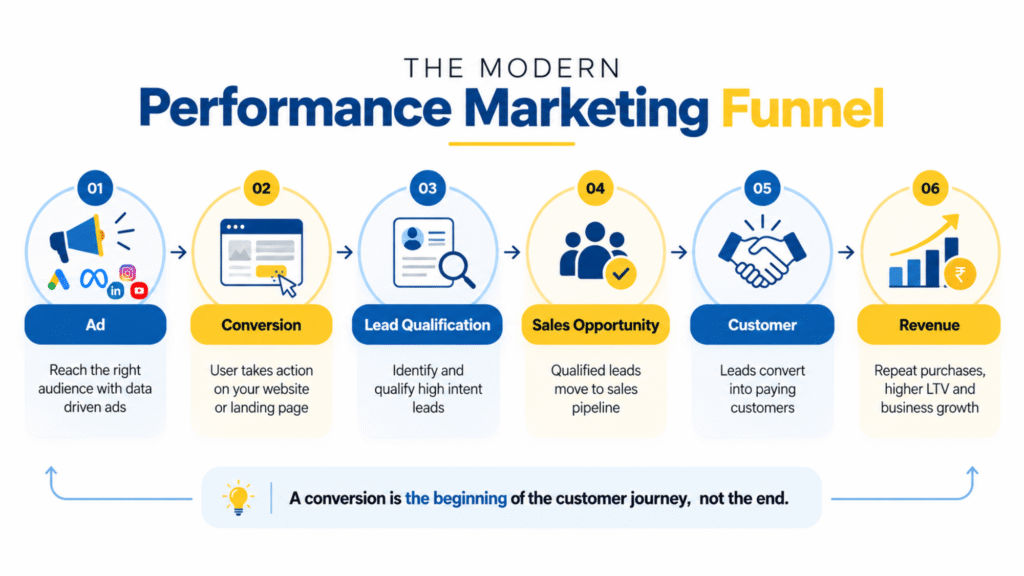
A stronger measurement framework connects:
Ad → Conversion → Lead Qualification → Sales Opportunity → Customer → Revenue
A Practical Performance Marketing Framework for 2026
Businesses should start treating performance marketing as a connected system rather than a collection of advertising campaigns.
1. Advertising
Reach the right potential customers through relevant platforms, campaigns, creative, messaging, and offers.
2. Conversion
Turn attention into a meaningful action such as a purchase, lead, consultation, demo, or application.
3. Lead Qualification
Determine which conversions represent genuine business opportunities.
4. Sales Opportunity
Connect marketing data with sales and CRM information to understand which qualified leads become opportunities.
5. Customer
Measure how many opportunities become actual customers.
6. Revenue
Connect marketing activity with the final business outcome.
This creates an important principle:
Do not optimize the top of the funnel without understanding what happens at the bottom.
What AI Changes vs. What Remains Human
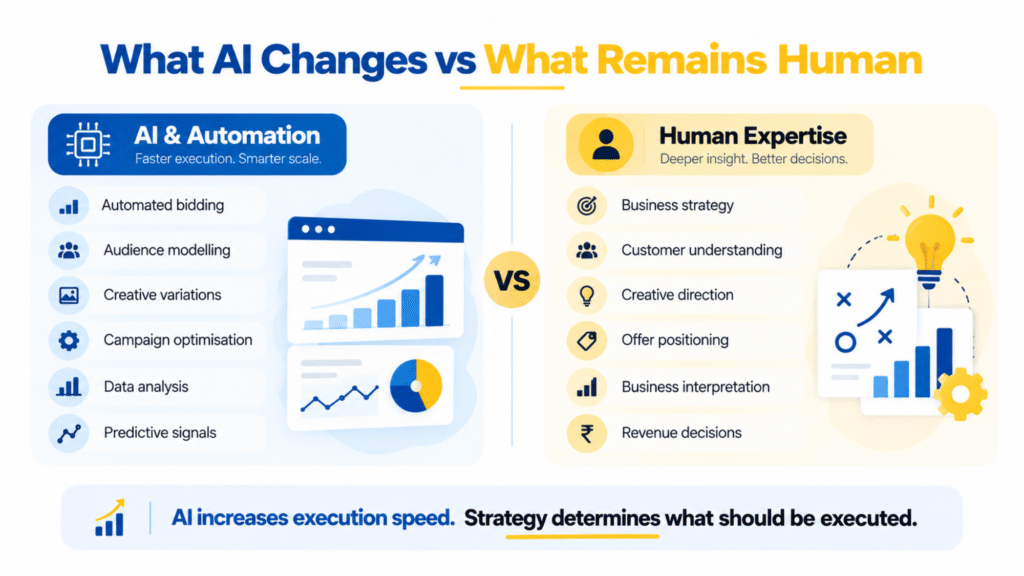
AI is increasingly useful for speed, scale, automation, pattern recognition, and repetitive execution.
Humans remain important for context, judgment, positioning, and business decisions.
AI can help with:
- Campaign optimization
- Data analysis
- Creative variations
- Automated bidding
- Audience discovery
- Reporting
- Repetitive execution
Humans remain responsible for:
- Business strategy
- Customer understanding
- Offer positioning
- Creative direction
- Funnel design
- Measurement strategy
- Lead quality
- Revenue interpretation
The marketer’s role is therefore changing from manually controlling every campaign setting to deciding what should be optimized and why.
How Businesses Should Approach Performance Marketing in 2026
Businesses should not treat AI as a shortcut.
A practical approach is to:
- Define the business objective.
- Identify what a valuable conversion means.
- Strengthen conversion tracking.
- Connect marketing data with sales and CRM data.
- Improve the quality of conversion signals.
- Use AI to automate repetitive work and improve efficiency.
- Keep human judgment focused on strategy and business decisions.
The goal is not to automate everything.
The goal is to automate repetitive work while improving the quality of human decisions.
The Future of Performance Marketing
Performance marketing in 2026 is becoming less about manually controlling every campaign setting and more about managing systems, signals, creative inputs, customer journeys, and business outcomes.
AI will continue to influence bidding, targeting, creative production, reporting, and optimization.
But businesses still need to understand their customers, create relevant offers, build trust, measure outcomes, and connect marketing activity with revenue.
The biggest opportunity is therefore not simply using more AI.
It is using AI within a better performance marketing system.
The practical takeaway for businesses is simple:
Use AI for speed and scale, but strengthen the strategy, data, creative direction, measurement, and business understanding that guide it.
