

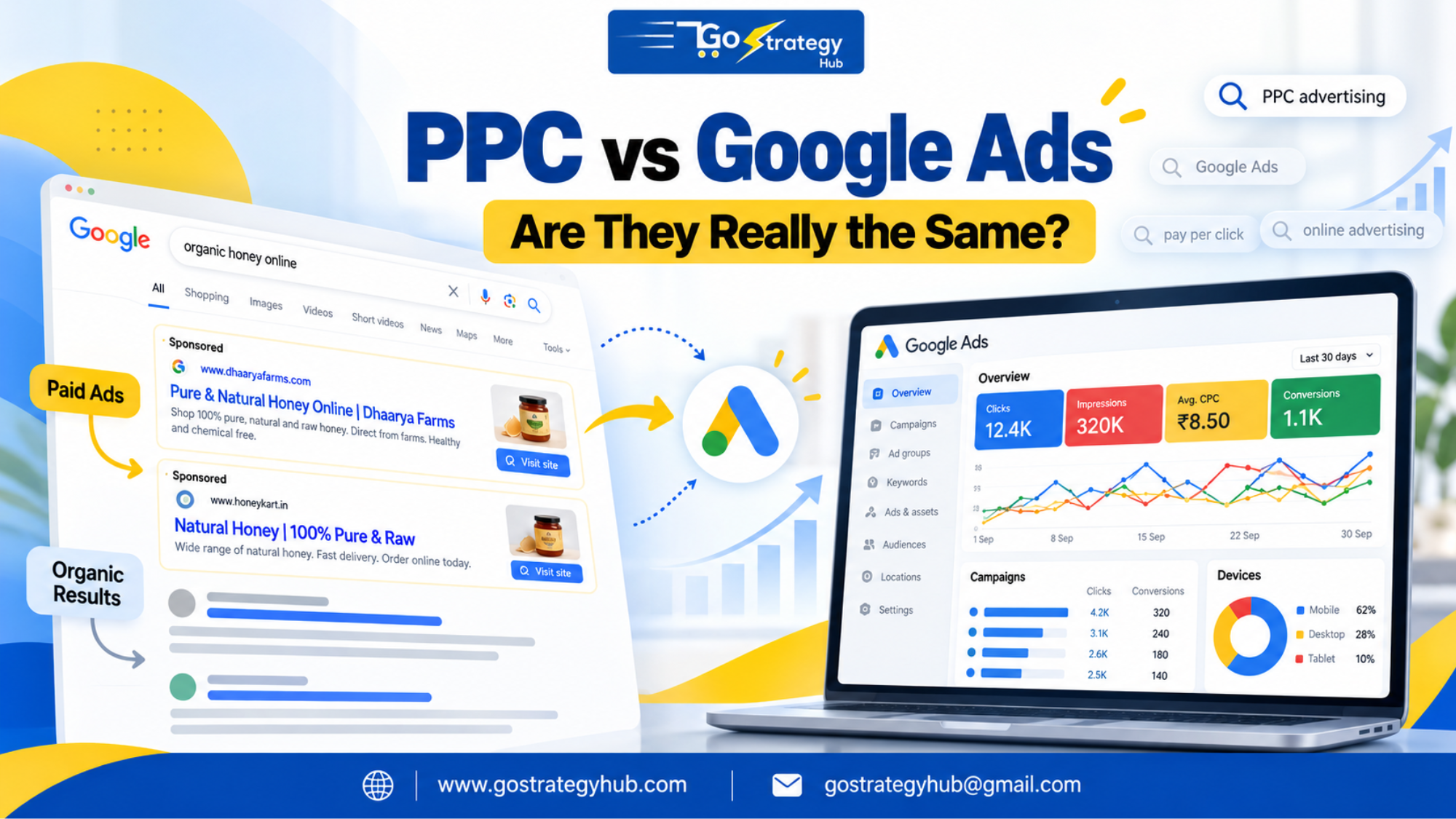
Do you think PPC and Google Ads are the same thing?
If you are new to online advertising, you may have heard both terms used in the same conversation. A business owner might say, “We need PPC advertising,” while a marketer might say, “We should run Google Ads.” This can make it sound like PPC and Google Ads are two different names for the same thing.
They are related, but they are not the same.
PPC is an advertising model, while Google Ads is an advertising platform. Google Ads can be used for PPC advertising, but PPC is a much broader term.
Understanding this difference is useful before you start spending money on paid advertising because it helps you understand what you are actually paying for and how different types of campaigns work.
What Is PPC?
PPC stands for Pay Per Click. It is an online advertising model where an advertiser generally pays when someone clicks on their advertisement.
For example, imagine you run a website development company. Someone searches Google for “website development company for small business.” Your advertisement may appear in the search results. If that person clicks on your advertisement, you may be charged for that click.
That is PPC advertising.
The important thing to understand is that PPC does not refer to only one advertising platform. It describes the way the advertising model works. Different advertising platforms can offer campaigns where advertisers pay based on clicks.
This is why saying “PPC” and saying “Google Ads” are not exactly the same thing.
What Is Google Ads?
Google Ads is Google’s advertising platform that allows businesses to promote their products and services across Google’s advertising network.
One of the most familiar forms is Google Search Ads. These are the advertisements that can appear when someone searches for a product, service or answer on Google.
For example, if someone searches for “best performance marketing agency in Mumbai,” businesses targeting relevant searches may have an opportunity to show an advertisement.
Google Ads is not limited to one format, though. Depending on the campaign and objective, businesses can use different types of advertising campaigns to reach potential customers.
So, a simple way to remember the difference is:
PPC describes the advertising model, while Google Ads is the platform.
How Does Google Search Advertising Work?
Google Search Ads are particularly interesting because they can reach people when they are already searching for something.
Suppose you own a dental clinic. Someone searches for “dentist near me.” They already have a requirement and are actively looking for a solution.
If your advertisement appears for a relevant search, that person may click the ad, visit your website or landing page, call your business or submit an enquiry.
This is one reason search advertising can be valuable for businesses that offer services people actively search for.
However, simply creating an advertisement does not guarantee that it will appear at the top of Google.
Google considers several factors when determining which ads are eligible to appear and where they may appear. Your bid, the relevance of your advertisement and landing page, the competition for the search and other factors can influence the outcome.
This is where keywords become important.
What Are Keywords in Google Ads?
Keywords are words or phrases that advertisers use to tell Google what searches their advertisements should be relevant to.
For example, a performance marketing agency might consider keywords such as:
- performance marketing agency
- performance marketing services
- Google Ads agency
- Facebook Ads agency
- PPC agency
The keyword you choose should be connected to the product or service you actually offer.
But keyword selection is not simply about adding hundreds of keywords to a campaign. The quality and relevance of those keywords matter because the people searching those terms should have a reasonable chance of becoming customers.
For example, if you provide paid advertising services to businesses, a search such as “Google Ads agency for business” may be more commercially relevant than a search such as “what is Google Ads.”
Both searches are related to Google Ads, but the intent behind them is different.
That difference in search intent is extremely important in paid advertising.
What Are Keyword Match Types?
Google Ads provides different ways to control how closely a user’s search needs to relate to your selected keywords.
The main match types are Broad Match, Phrase Match and Exact Match.
Understanding these match types is important because they can influence how widely your ads can match to searches.
Broad Match
Broad match gives Google the most flexibility to find searches related to the meaning and intent of your keyword.
For example, if your keyword is related to “performance marketing agency,” your ad may be eligible for searches that Google considers relevant to that concept, even when the search does not contain the exact same words.
This can help advertisers discover additional relevant searches and reach a wider audience.
However, broader targeting also means you need to monitor your search terms carefully. Not every related search will necessarily be valuable for your business.
For example, someone looking for a free course, a job or basic information may not be a potential customer for a paid service.
Phrase Match
Phrase match provides more control while still allowing Google some flexibility in matching your keyword to relevant searches.
For example, you might use:
“performance marketing agency”
A user could search for something such as “performance marketing agency in Mumbai” or “best performance marketing agency for B2B,” and Google may consider those searches relevant depending on the overall context and matching system.
Phrase match can be useful when you want to keep your targeting closely connected to a particular phrase while still reaching variations of relevant searches.
Exact Match
Exact match gives advertisers tighter control over the searches their keywords can match to, although the term “exact” does not mean the user’s search has to contain precisely the same words.
For example:
[performance marketing agency]
Google can still match an exact match keyword to searches that have the same meaning or intent.
This is important because modern search advertising is not based only on identical words. Google also uses its understanding of the meaning behind a search.
What Are Negative Keywords?
There is another important part of keyword management called negative keywords.
Negative keywords tell Google which searches you do not want your advertisements to show for.
For example, suppose you provide professional website development services and you do not offer courses or employment opportunities.
You may want to avoid searches such as:
- website development course
- website developer jobs
- free website development
- website development tutorial
These searches may be related to your industry, but the people searching them may not be looking to purchase your service.
Negative keywords can therefore help reduce irrelevant traffic and make your advertising more focused.
Why Choosing the Right Keywords Matters
One of the biggest mistakes beginners make with Google Ads is focusing only on the number of clicks.
Getting more clicks may look positive inside an advertising dashboard, but clicks alone do not tell you whether the campaign is helping the business.
Imagine two campaigns.
The first campaign gets 500 clicks, but only a few people are genuinely interested in the service.
The second campaign gets 100 clicks, but those visitors are highly relevant and several become customers.
The second campaign may be much more valuable even though it generated fewer clicks.
This is why businesses should look beyond metrics such as clicks, CTR and CPC.
For lead generation campaigns, the journey should ideally be understood as:
Click → Lead → Qualified Lead → Customer → Revenue
The real question is not simply, “How many clicks did we get?”
It is, “What happened after those clicks?”
PPC vs Google Ads: What Should a Business Use?
The answer depends on what the business is trying to achieve.
If people are actively searching for your product or service, Google Search Ads can be a strong option because you can reach users based on what they are searching for.
For example, a person searching for “AC repair service near me” has a very different intent from someone who is simply watching a video about home maintenance.
On the other hand, businesses may also use other forms of paid advertising to create awareness, reach new audiences and generate demand before someone searches for the product.
This is why choosing an advertising platform should start with the business objective and customer journey, rather than simply choosing a platform because everyone else is using it.
Final Thoughts
So, are PPC and Google Ads the same?
No.
PPC is a broader advertising model based on paying for clicks, while Google Ads is Google’s advertising platform. Google Ads can be used for PPC campaigns, particularly Search Ads, but the two terms should not be treated as synonyms.
If you are new to Google Ads, start by understanding the basics: how search advertising works, what keywords are, how match types work and why negative keywords matter.
Most importantly, don’t judge your campaign only by how many clicks or leads it generates. A successful campaign should ultimately contribute to qualified opportunities, customers and revenue.
Because for a business, the cheapest click is not always the most valuable click.
