

India’s ride-hailing market is becoming more competitive. For many years, Uber and Ola were the two major names people considered when booking a cab. Today, Rapido is changing the competition.
Rapido started with bike taxis and focused on affordable, everyday travel. Over time, it expanded into auto-rickshaws and cab services. Its growth shows how understanding customer needs can help a business compete with much bigger companies.
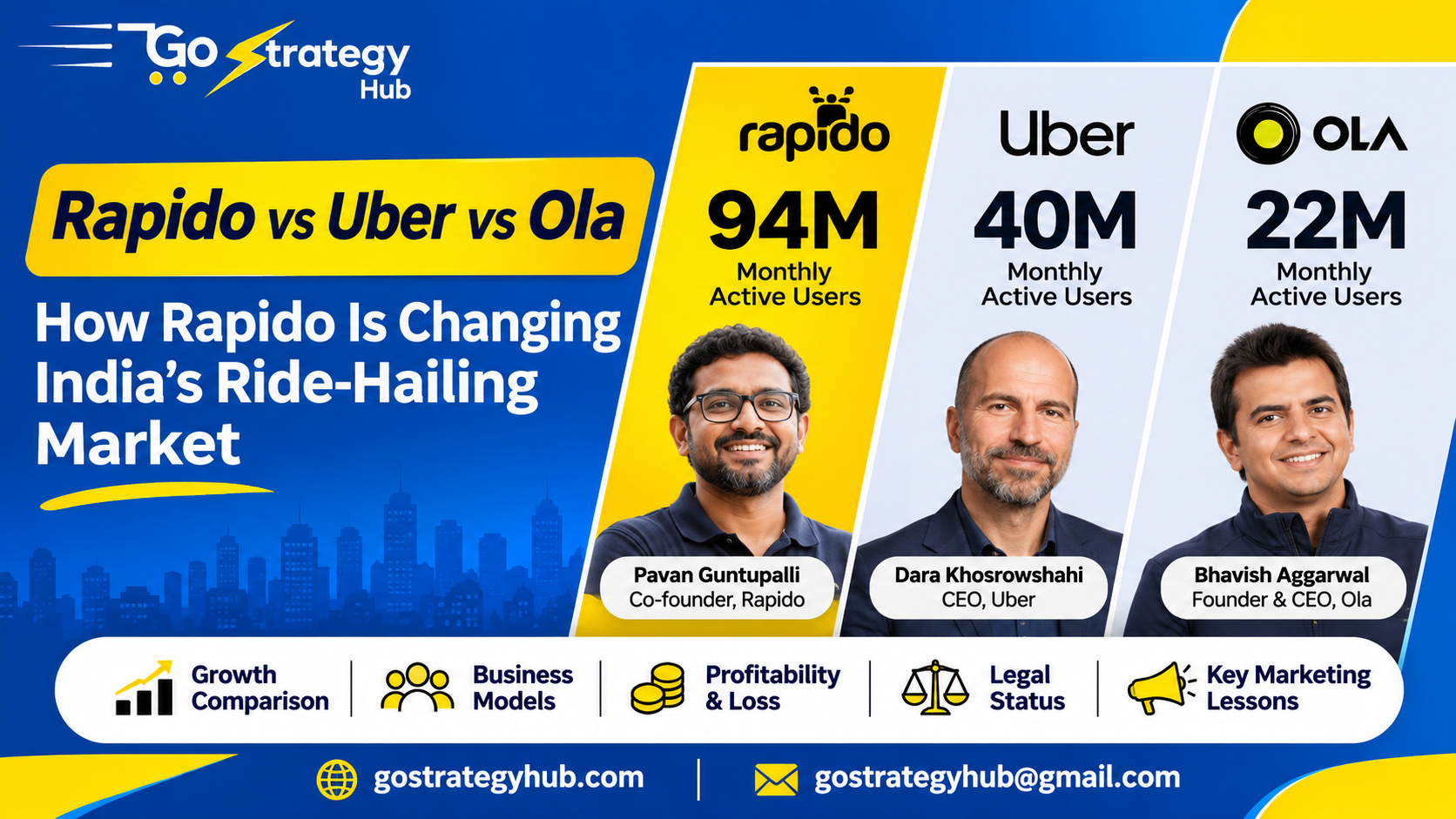
According to Sensor Tower estimates, Rapido reached 94 million monthly active users in September–October 2026. Uber had 40 million, while Ola had 22 million users during the same period.
These numbers have started an important discussion: Is Rapido becoming bigger than Uber and Ola in India?
But there is more to this story than user numbers. Its pricing, business model, customer experience and marketing strategy offer useful lessons for business owners.
1. Rapido vs Uber vs Ola: Who Is Leading the Market?
Let’s compare the three ride-hailing platforms.
| Company | Monthly active users |
|---|---|
| Rapido | 94 million |
| Uber | 40 million |
| Ola | 22 million |
Source: Sensor Tower estimates, September–October 2026.
Rapido has more monthly active users than Uber and Ola combined, based on these estimates.
However, monthly active users do not mean completed rides or paying customers. A person opening an app is counted as an active user, even if they do not book a ride.
This is an important difference when comparing business performance.
Rapido has built a strong position in bike taxis and everyday mobility. Uber remains a major competitor in the cab segment, while Ola is trying to maintain its position in a changing market.
2. How Did Rapido Become Popular in India?
Rapido was founded in 2015 by three entrepreneurs: Aravind Sanka, Pavan Guntupalli and Rishikesh SR.
The company started with a simple idea: make short-distance travel more affordable and convenient.
In Indian cities, traffic is a common problem. Travelling even a few kilometres can take a lot of time, especially during office hours.
Rapido identified an opportunity in this market.
Instead of focusing only on traditional cab bookings, it introduced bike taxis as an alternative for everyday travel.
Its main customer benefits included:
- Affordable short-distance travel.
- Faster movement through traffic.
- Easy booking through a mobile application.
- More options for everyday commuting.
Later, Rapido expanded into auto-rickshaws and cab services.
This helped the company serve customers with different travel requirements.
3. What Makes Rapido’s Business Model Different?
One interesting part of Rapido’s growth is its business model.
The company has used a subscription-based model for its auto and cab driver partners.
Under this model, drivers pay a fixed subscription fee to access the platform instead of paying a commission on every ride.
Its bike-taxi business, however, operates on a commission basis.
This difference is important because a company’s business model affects its revenue, driver relationships and ability to compete.
For drivers, the subscription model offers a different way to manage their earnings.
For Rapido, it creates another source of revenue while helping the platform expand its mobility services.
The company is not only competing through pricing. It is also experimenting with how it creates value for drivers and customers.
4. Is Rapido in Loss or Profit?
Rapido’s growth in users does not automatically mean that the company is profitable.
According to its FY25 financial results, its operating revenue reached approximately ₹934 crore, compared with ₹648 crore in FY24.
However, the company reported a net loss of approximately ₹258 crore in FY25.
The good news is that its losses reduced from around ₹371 crore in FY24.
| Financial metric | FY24 | FY25 |
|---|---|---|
| Operating revenue | ₹648 crore | ₹934 crore |
| Net loss | ₹371 crore | ₹258 crore |
These figures show that Rapido increased its revenue while reducing its losses.
For any startup, this is an important stage of business growth.
Acquiring customers is one challenge. Managing operating expenses, driver incentives, technology costs and customer acquisition costs is another.
A company must eventually convert its customer base into sustainable revenue and profit.
5. Who Is Aravind Sanka in Rapido?
Aravind Sanka is one of the three co-founders of Rapido.
Along with Pavan Guntupalli and Rishikesh SR, he helped build the company in 2015.
Aravind Sanka has played an important role in the company’s expansion and business strategy.
The founders identified an opportunity in India’s urban transportation market and built a platform around affordable mobility.
Their journey is a useful example of how understanding an everyday customer problem can lead to a large business opportunity.
6. Is Rapido Bigger Than Uber?
Based on the latest Sensor Tower monthly active user estimates, Rapido is ahead of Uber in India.
Rapido recorded 94 million monthly active users, while Uber recorded 40 million.
However, there is an important difference between being bigger in app usage and being bigger as a business.
Uber operates across many countries and has a global business. Rapido’s comparison here is limited to the Indian ride-hailing market.
Uber also remains strong in the four-wheeler cab segment.
Therefore, Rapido’s lead in monthly active users does not mean it has surpassed Uber in every business category.
7. Is Rapido Legal or Illegal in India?
The legality of bike taxis has been an important discussion in India.
Bike taxi regulations can differ between states. Companies must follow the applicable transport rules, registration requirements, permits and aggregator guidelines.
In January 2026, the Karnataka High Court allowed bike taxi services to operate in the state and set aside an earlier order that had effectively stopped these services.
This shows that the legal position has developed over time.
However, it does not mean every bike taxi service can operate without restrictions everywhere in India.
Rapido and other mobility platforms must follow the applicable rules in the locations where they operate.
8. Uber’s Founders, CEO and Business History
Uber is an American technology company founded in 2009.
Its original CEO was Travis Kalanick, who co-founded the company with Garrett Camp.
In 2017, Dara Khosrowshahi became Uber’s CEO after Travis Kalanick stepped down.
Dara continues to serve as Uber’s global CEO.
When discussing the Uber CEO in India, it is important to distinguish between global leadership and country-level management.
Prabhjeet Singh previously served as President of Uber India and South Asia, but stepped down in June 2026. His departure should not be confused with a change in Uber’s global CEO.
Uber is also a publicly listed company, so it does not have one individual owner in the traditional sense. Its shares are held by different investors and shareholders.
Although some major shareholders and executives are wealthy, it is not accurate to describe one person as the sole billionaire owner of Uber.
9. Ola vs Uber: Which Company Came First?
There are two ways to understand this comparison.
Uber was founded globally in 2009, while Ola was founded in India in 2010.
However, Ola entered the Indian ride-hailing market before Uber launched its Indian operations in 2013.
Ola is an Indian company founded by Bhavish Aggarwal and Ankit Bhati.
It started as a cab-booking platform and expanded into other mobility services.
Over the years, Ola has also attracted major investors.
One well-known investor was Ratan Tata, who invested in Ola in 2015 through RNT Associates.
Bhavish Aggarwal is the co-founder of Ola and has also founded Ola Electric and Krutrim.
Forbes included him in its 2025 billionaire list, with an estimated net worth of around $2 billion at that time. Personal wealth estimates can change with company valuations and share prices.
10. What Marketing Lessons Can Businesses Learn From Rapido?
Rapido’s growth offers several useful lessons for startups, D2C brands and established businesses.
Understand the customer problem
Rapido focused on everyday transportation needs instead of trying to sell only another cab-booking service.
Businesses should understand what customers actually want before investing in advertising.
Make pricing part of your strategy
Customers compare prices before making decisions.
A strong pricing strategy can help a business attract new customers and encourage repeat purchases.
However, low prices alone cannot build a successful company. The business must also manage its costs.
Focus on customer acquisition and retention
Getting a new customer is important, but bringing that customer back is equally important.
Businesses should focus on customer experience, follow-up communication, loyalty programmes and repeat purchases.
Build a strong marketing funnel
A successful business needs more than advertising campaigns.
It needs a complete system:
- Understand the target audience.
- Create the right offer.
- Run relevant advertising campaigns.
- Improve the website or app experience.
- Track customer actions and conversions.
- Follow up with potential customers.
- Build repeat sales and customer retention.
Measure business growth, not just clicks
A campaign may generate thousands of clicks but very few actual customers.
Businesses should track important metrics such as:
- Customer acquisition cost (CAC).
- Cost per lead (CPL).
- Conversion rate.
- Return on ad spend (ROAS).
- Customer lifetime value (LTV).
- Repeat purchase rate.
These metrics help businesses understand whether their marketing is generating real business results.
11. What Does Rapido’s Growth Mean for Performance Marketing?
Rapido’s journey highlights an important point: marketing is not just about running advertisements.
A company needs to understand its customers, pricing, product positioning and overall business model.
The same approach applies to D2C brands, service businesses and startups.
For example, a D2C company may generate sales through Google Ads and Meta Ads. But if customers never purchase again, the business will need to spend continuously on acquiring new customers.
This is why performance marketing should include more than paid advertising.
It should connect:
- Advertising and creative strategy.
- Landing pages and website conversion.
- Lead generation and sales follow-up.
- WhatsApp, email and CRM automation.
- Customer retention and repeat purchases.
This creates a complete growth system instead of depending only on advertising budgets.
Conclusion
Rapido’s rise is an interesting example of how a company can challenge established competitors by understanding customer behaviour and building a different business model.
Its growth against Uber and Ola shows that businesses do not always need to compete in the same way as established players.
Sometimes, finding an underserved customer segment and solving a simple problem can create a major opportunity.
However, the next challenge for Rapido will be maintaining customer growth, improving profitability and building a sustainable business.
For business owners, the biggest lesson is simple:
Don’t focus only on getting more customers. Focus on building a business that gives customers a reason to return.
If your business wants to generate more leads and sales through Google Ads and Meta Ads, work with a team that understands the complete customer journey.
GoStrategyHub – Performance Marketing Agency in Mumbai
We help businesses build performance marketing strategies through Google Ads, Meta Ads, conversion tracking, landing pages, lead generation and marketing automation.
