

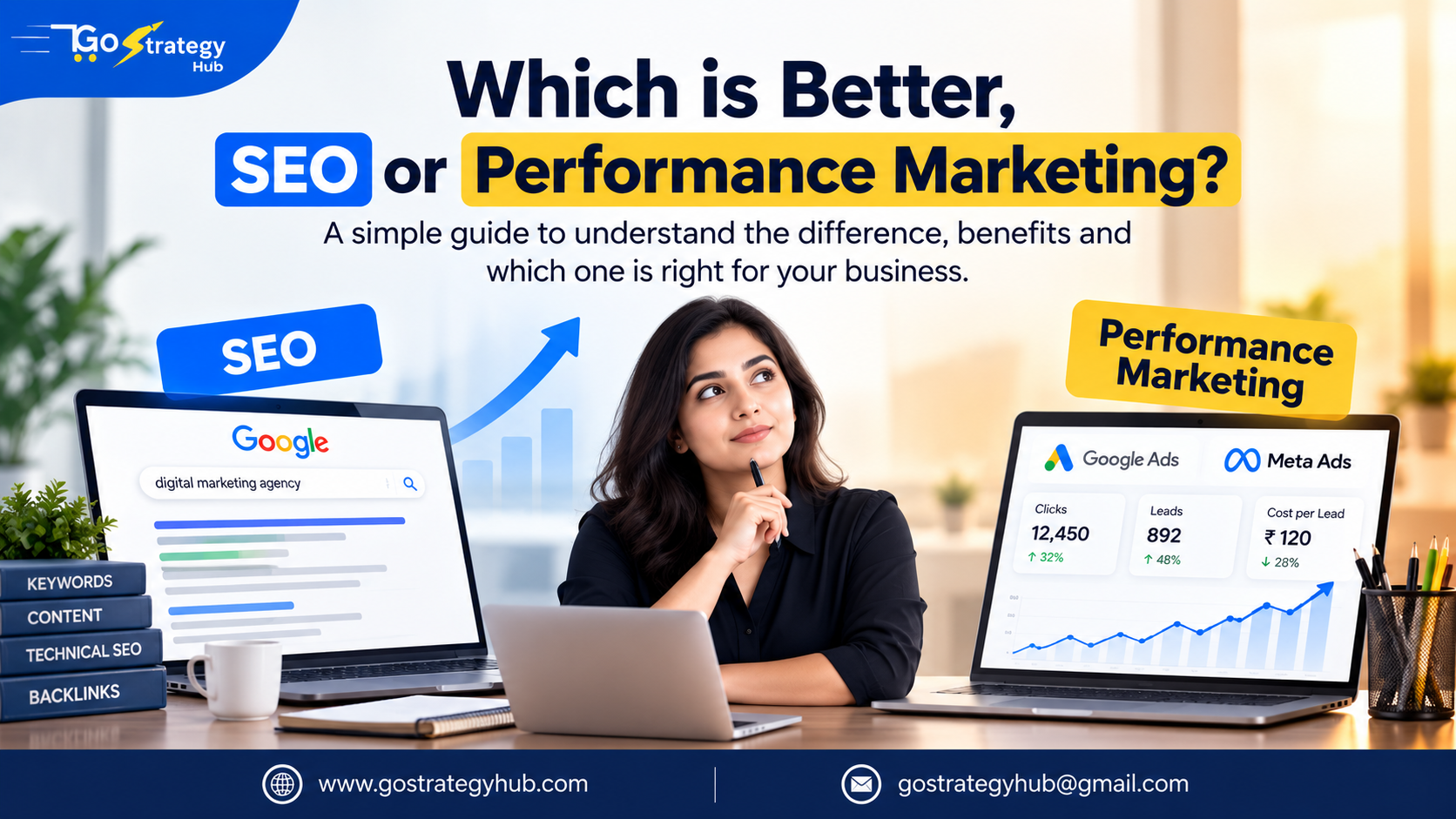
If you are trying to grow your business online, you have probably come across two common strategies: SEO and performance marketing.
Both can bring visitors, leads, and customers to your business. But they work in very different ways.
SEO focuses on building visibility in organic search results, while performance marketing uses paid advertising to reach the right audience and generate measurable results.
So, which one should you choose?
The answer depends on what your business needs right now.
If you are looking for a performance marketing agency in Mumbai, for example, you may need leads quickly. In that case, paid campaigns can be useful. But if your goal is to build a steady source of organic traffic over time, SEO can be a better investment.
Let’s understand the difference.
What Is SEO?
SEO stands for Search Engine Optimization.
It means improving your website and content so that your business can appear higher in organic search results on Google and other search engines.
For example, imagine you provide digital marketing services in Mumbai.
A potential customer searches:
“Best performance marketing agency in Mumbai”
If your website appears among the top organic results, that person may visit your website and contact you.
SEO usually involves:
• Finding topics and search terms your customers are looking for
• Creating useful and relevant content
• Improving website pages
• Fixing technical SEO issues
• Improving website speed and user experience
• Building relevant internal links
• Earning quality backlinks
• Regularly updating and improving content
The main idea is simple: help the right people find your business when they are searching for what you offer.
What Is Performance Marketing?
Performance marketing is focused on paid advertising and measurable business results.
Instead of waiting for your website to rank organically, you can use platforms such as Google Ads and Meta Ads to reach potential customers.
For example, a business looking for customers in Mumbai could run an advertising campaign promoting its services to a specific audience.
The campaign can be measured through things like:
• Ad spend
• Clicks
• Cost per click
• Leads
• Cost per lead
• Sales
• Conversion rate
• Revenue
• Return on ad spend
This makes performance marketing useful when you want to test an offer, reach a specific audience, or generate leads within a shorter time.
For example, a performance marketing agency in Mumbai may run Google Ads for a real estate company, targeting people actively searching for properties in specific locations.
SEO vs Performance Marketing: What Is the Difference?
The biggest difference is how you get traffic.
With SEO, you work towards earning organic visibility in search results.
With performance marketing, you pay for advertising space and target specific audiences.
Here is a simple comparison:
| SEO | Performance Marketing |
|---|---|
| Focuses on organic traffic | Focuses on paid traffic |
| Usually takes time | Can start generating traffic quickly |
| Builds long term visibility | Designed for measurable campaigns |
| Content plays an important role | Ads and offers play an important role |
| No payment for every organic click | Requires an advertising budget |
| Can build authority over time | Makes testing and optimization easier |
| Results can continue after the initial work | Traffic generally depends on ongoing campaigns |
Neither approach is automatically better.
The right choice depends on your business, competition, budget, and goals.
Which Gives Faster Results?
If speed is important, performance marketing usually has the advantage.
Suppose you have launched a new service and want to generate enquiries this month.
You can create a Google Ads or Meta Ads campaign, choose your audience, set a budget, and start testing your campaign.
SEO does not work that way.
You might publish a well-written article today, but it may take time before the page gains visibility and starts bringing consistent organic traffic.
This is why businesses that need leads quickly often consider working with a performance marketing agency in Mumbai or another agency that understands their target market and advertising goals.
However, faster traffic does not automatically mean better results.
Your landing page, offer, targeting, ad copy, sales process, and follow-up all matter.
Which Is Better for Long Term Growth?
SEO can be very useful for building long term organic visibility.
Think about a business that regularly publishes helpful content based on the questions its customers ask.
One article may bring a small amount of traffic today.
But if several useful pages begin ranking for relevant searches, the website can build a strong source of organic traffic over time.
SEO can also help build trust.
When people repeatedly find your business while searching for useful information, they may become more familiar with your brand.
But SEO is not something you do once and forget.
Competitors can publish better content. Search results can change. Your website can develop technical issues.
So SEO needs regular attention.
Which Is Better for Lead Generation?
This depends on your industry and customer journey.
Performance marketing can be especially useful when you have a clear offer and want to generate leads from a specific audience.
For example, a B2B company could run LinkedIn or Google campaigns for a particular service.
A local business could use Google Ads to reach people searching for its services.
An e-commerce company could use Meta or Google advertising to promote products.
The important thing is to measure the entire journey.
Getting 100 leads sounds good.
But what if only 5 of those leads become customers?
That is why good performance marketing is not simply about getting more clicks or leads. The focus should be on getting useful results at a sustainable cost.
What About Cost?
There is a common misunderstanding that SEO is free because you do not pay for every click.
That is not really the case.
SEO requires time, strategy, content, technical work, tools, and expertise.
Performance marketing also requires investment. You need an advertising budget, and there may also be costs for campaign management, creative work, landing pages, and tracking.
So instead of asking:
“Which one is cheaper?”
Ask:
“Which one can generate profitable results for my business?”
That is a much better way to look at marketing costs.
A Simple Example
Let’s say you run a fitness coaching business in Mumbai.
You want to get more customers.
If you choose performance marketing
You could create an offer such as:
“Book a Free Fitness Consultation.”
You can run Meta Ads or Google Ads and send interested people to a landing page.
You can then track:
How many people clicked the ad?
How many filled out the form?
How much did each lead cost?
How many leads became paying customers?
This gives you a clear picture of campaign performance.
If you choose SEO
You could create helpful content around topics your potential customers search for.
For example:
“Beginner Workout Plan for Busy Professionals”
“How Much Protein Do You Need Every Day?”
“Best Exercises for Beginners”
People searching for these topics may discover your website through Google.
Some of them may eventually become customers.
The difference is the timeline.
Performance marketing can help you reach potential customers faster, while SEO can help you build organic visibility over time.
Can You Use SEO and Performance Marketing Together?
Yes.
In fact, many businesses can benefit from using both.
Performance marketing can help you generate traffic and test different offers quickly.
SEO can help you build organic visibility and reduce your dependence on paid traffic over the long term.
For example, suppose your paid campaign shows that customers respond very well to a particular service.
You can use that information when creating website content, landing pages, and SEO campaigns.
At the same time, your SEO content can bring organic visitors who may later become customers.
So instead of thinking:
SEO vs Performance Marketing
it can be more useful to think:
SEO + Performance Marketing
when your budget and business goals support both.
When Should You Choose SEO?
SEO may be a good choice if:
• You want to build long term organic traffic
• Your customers regularly search for your products or services
• You want to improve your website visibility
• You are willing to wait for results
• You want to build useful content around your industry
• You want to build a stronger organic presence over time
When Should You Choose Performance Marketing?
Performance marketing may be a better starting point if:
• You need leads or sales quickly
• You have a clear product or service offer
• You have an advertising budget
• You want to reach a specific audience
• You want to test different offers and messages
• You want to measure your advertising results closely
If you are comparing agencies, look beyond promises of “more leads.” A good performance marketing agency in Mumbai should be able to explain how campaigns will be tracked, what metrics matter, where the budget is going, and how results will be improved.
So, Which Is Better: SEO or Performance Marketing?
There is no single answer.
SEO is a long term strategy for building organic visibility.
Performance marketing is a paid strategy designed to reach the right audience and measure business results.
If you need customers quickly, performance marketing may make more sense.
If you want to build organic visibility for the long term, SEO can be valuable.
And if you have the resources, combining both can give your business more ways to reach potential customers.
The important thing is not to choose a marketing channel simply because everyone else is using it.
Choose the one that matches your business goals, customer journey, budget, and timeline.
Looking for More Leads Through Paid Advertising?
If you want to generate more leads through Google Ads or Meta Ads, working with the right strategy can make a big difference.
