

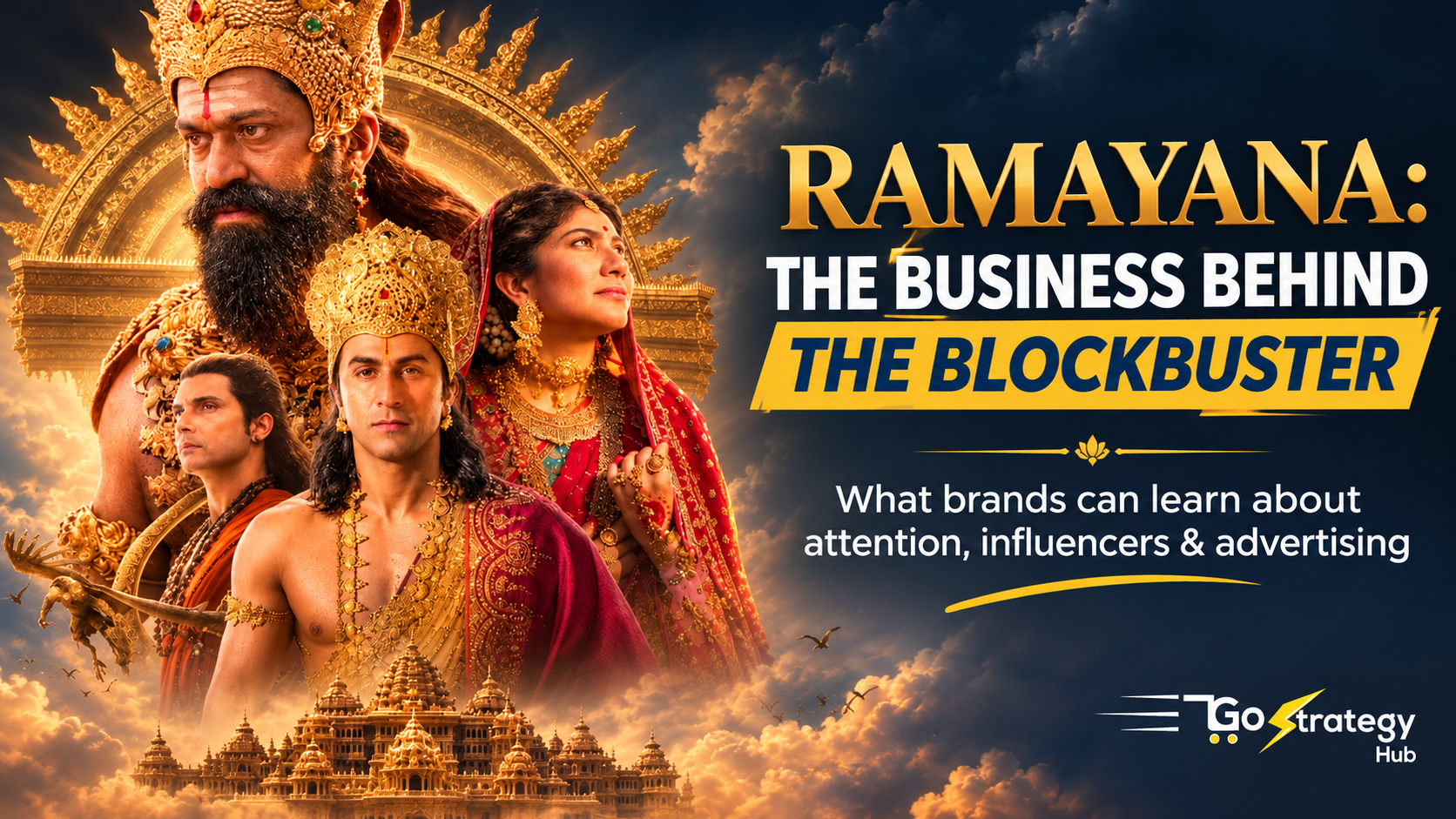
What happens when a film becomes bigger than entertainment?
People discuss it, creators make videos about it, influencers share opinions, brands compete for advertising space, and social media keeps the conversation alive.
That is the interesting business story behind Ramayana.
With a reported combined investment of approximately ₹4,700 crore for two films and an estimated ₹80–100 crore cinema advertising opportunity, Ramayana is demonstrating something important: attention can become a powerful commercial asset.
But the most interesting part isn’t just the money. It is how the film has created demand across cinema, social media and brand advertising.
1. ₹4,700 Crore Investment: Why Make Two Films?
Producer Namit Malhotra has spoken about an investment of approximately $500 million for both parts of Ramayana.
Why not release the entire story in one film?
Because the makers wanted enough time to develop the epic’s characters, storytelling and visual scale. A single film would have required significant compromises.
But splitting the story also creates a long-term commercial opportunity.
- Two theatrical releases instead of one.
- Two major promotional campaigns.
- More opportunities for international distribution.
- Potential revenue from OTT, satellite rights and merchandise.
- An opportunity to build a recognisable entertainment franchise.
Part One released on November 5, 2026, with Part Two planned for 2028.
The important point is that ₹4,700 crore is the reported combined project investment, not the confirmed cost of Part One alone.
2. Box Office Revenue Is Not the Same as Profit
According to The Indian Express, Ramayana had collected approximately ₹1,110 crore worldwide by November 14.
That sounds enormous. But does it mean the investment has been recovered?
Not necessarily.
Theatrical collections are shared across exhibitors, distributors and other commercial arrangements. The producer does not receive the entire box-office gross.
There are also other revenue opportunities, including digital streaming, satellite rights and merchandise.
The bigger business strategy is to recover the investment through multiple revenue channels rather than depending only on cinema tickets.
This is a lesson in building a business model around one major product.
3. Why Are Influencers Promoting Ramayana Without Being Asked?
This is perhaps the most interesting part of its marketing story.
Look at Instagram and Facebook. Creators are discussing the film, sharing trailers, making reels, creating memes, debating visuals and giving their opinions.
But is every creator being paid?
No public evidence establishes that all this creator activity is paid promotion. Some content may be part of official collaborations, while much of it can be independent audience participation.
Why does this happen?
Because people share things that give them something to talk about.
Ramayana already has cultural recognition. Add a massive production, familiar characters, popular actors and public curiosity, and people have multiple reasons to create content.
This is called earned media.
A brand pays for advertising, but earned media happens when people voluntarily discuss, recommend or share something.
The marketing opportunity is significant: one official trailer can generate thousands of independent reactions, discussions and videos.
Brands should understand that creating something worth discussing can be more powerful than simply paying more influencers to promote it.
4. Why Social Media Is So Powerful for Advertising
Cinema creates attention, but social media extends that attention.
Someone watches a trailer, shares it on Instagram, discusses it on Facebook, watches a creator’s review and sends it to friends.
One piece of content can travel through multiple communities.
This is why social platforms have become important advertising channels.
With Facebook advertising and Instagram campaigns, brands can reach audiences based on interests, behaviour, demographics and other available targeting signals.
More importantly, Meta Ads allow businesses to amplify content that is already attracting attention.
For example:
- Publish an interesting video or campaign.
- Observe audience reactions and engagement.
- Identify the content that attracts relevant attention.
- Use Meta ads to reach a wider, relevant audience.
- Retarget interested people and measure conversions.
Organic attention creates an opportunity. Paid advertising helps businesses scale it.
5. Five Marketing Lessons Brands Should Learn
1. Create conversations, not just advertisements. Give people a reason to discuss your product.
2. Build curiosity before selling. Strong campaigns create interest before asking for a purchase.
3. Use influencers strategically. Choose creators whose audiences genuinely connect with your category, not simply those with large follower counts.
4. Combine organic and paid marketing. Facebook ads management should not operate separately from content strategy, creative testing and audience engagement.
5. Measure more than reach. Track enquiries, website visits, purchases, customer acquisition costs and revenue. Viral content is not automatically profitable marketing.
Final Thoughts
Ramayana offers a powerful marketing lesson: the biggest advertising opportunity is not always created by the advertising budget.
It can be created by the attention, curiosity and conversations surrounding a product.
For brands, the objective should be to build something people want to talk about, use social media to extend those conversations and use paid advertising to turn attention into measurable business results.
Don’t just pay to reach an audience. Give the audience a reason to talk about you.
