

Running Facebook ads is easy. Getting consistent leads and sales from them is the real challenge.
Many businesses start Facebook advertising by creating one campaign, selecting an audience, adding an image or video and expecting customers to purchase immediately.
But customers do not always make buying decisions after seeing an advertisement once.
Some people have never heard about your business. Some know your brand but are still comparing options. Others have visited your website or checked your products but have not purchased yet.
This is where a Meta Ads funnel becomes important.
A properly planned funnel helps businesses connect with potential customers at different stages of their buying journey. Instead of showing the same advertisement to everyone, you create different campaigns and messages based on customer interest and behaviour.
In this guide, we will explain what a Meta Ads funnel is, how it works and how to create one for almost any business using Facebook advertising.
What Is a Meta Ads Funnel?
A Meta Ads funnel is a marketing strategy that moves potential customers from discovering your business to becoming paying customers through strategically planned advertisements.
It uses platforms such as Facebook and Instagram through Meta Ads Manager.
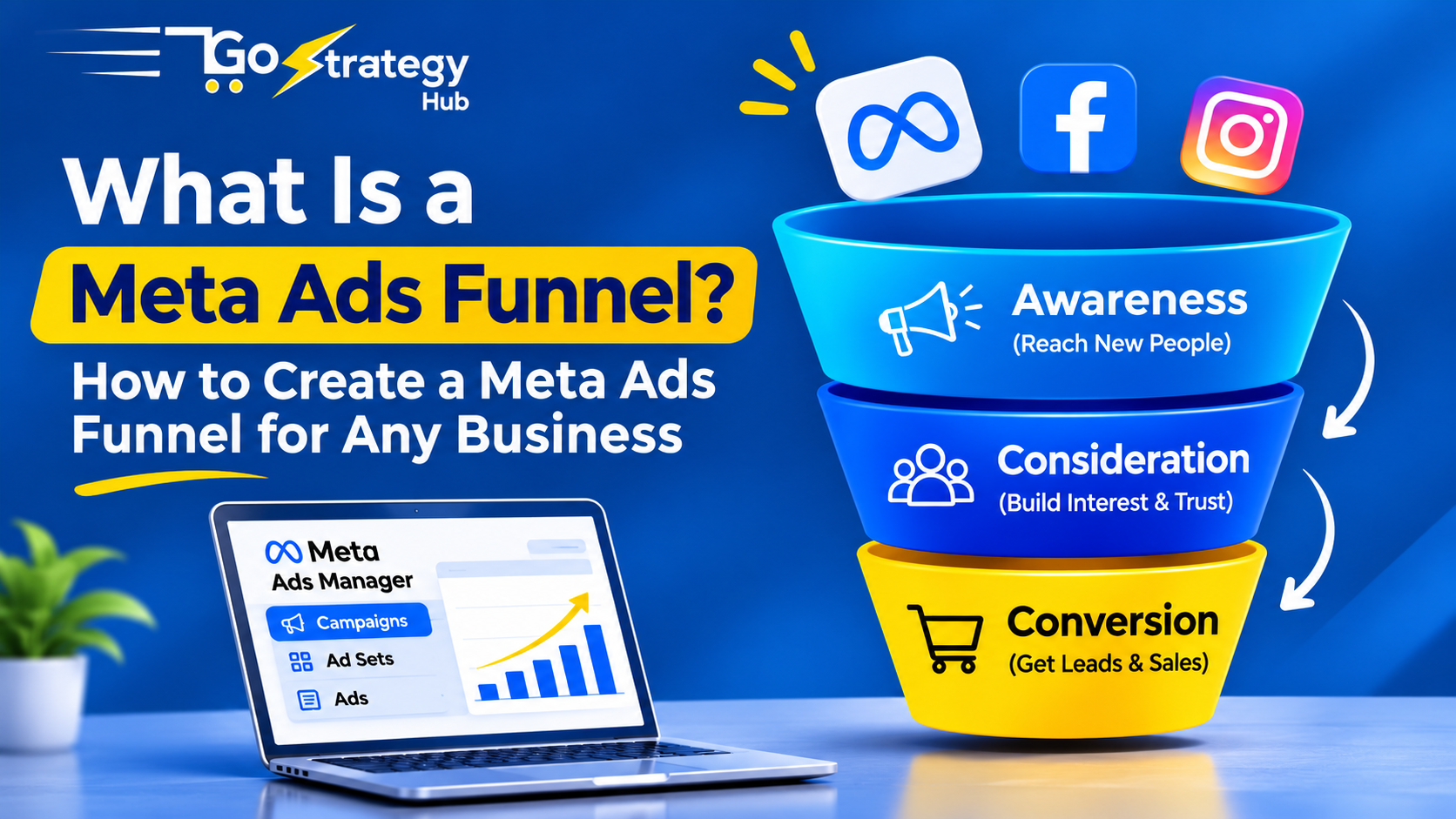
The funnel generally has three main stages:
- Top of Funnel (TOFU): Introduce your business to new audiences.
- Middle of Funnel (MOFU): Build interest and trust among potential customers.
- Bottom of Funnel (BOFU): Convert interested audiences into leads or customers.
For example, imagine you own an online clothing store.
- A person sees your clothing advertisement on Instagram.
- They watch your product video and visit your website.
- They check different products but leave without purchasing.
- Later, they see another advertisement showing customer reviews or a special offer.
- Finally, they return to your website and complete their purchase.
This complete journey is an example of a Meta Ads funnel.
Understanding the Three Stages of a Meta Ads Funnel
1. Top of Funnel (TOFU) – Awareness
The first stage is about introducing your business to people who have not interacted with your brand before.
At this stage, your audience may not know your business, products or services.
Your objective should be to attract relevant people and create awareness.
What type of ads should you run?
- Educational videos
- Product demonstration videos
- Brand introduction advertisements
- Problem-solving content
- Reels and engaging creatives
- New product launch advertisements
Audience targeting:
- Broad audiences
- Relevant interests
- Location-based audiences
- Lookalike audiences, where suitable
Suitable campaign objectives:
- Awareness
- Engagement
You can also use other objectives when the campaign’s actual goal requires them.
Example:
If you own a skincare brand, create a video explaining common skincare problems and introduce your products as a possible solution.
At this stage, focus on reaching relevant people rather than expecting every viewer to purchase immediately.
2. Middle of Funnel (MOFU) – Consideration
Now your audience has some awareness of your business.
They may have watched your videos, visited your Instagram profile, engaged with your Facebook page or explored your website.
However, they are not ready to purchase yet.
The purpose of this stage is to build trust, explain your value and encourage potential customers to take the next step.
What type of ads should you run?
- Customer testimonials
- Product benefits
- Detailed product demonstrations
- Case studies
- Before-and-after content, where appropriate
- Frequently asked questions
- Comparison advertisements
- Customer experience videos
Audience targeting:
- Video viewers
- Facebook and Instagram page engagers
- Instagram profile visitors
- Website visitors
- People who interacted with previous advertisements
Suitable campaign objectives:
- Engagement
- Traffic
- Leads
Choose the objective and performance goal according to the action you actually want.
Example:
For the same skincare brand, show customer experiences, product ingredients, usage demonstrations and answers to common questions.
The goal is to help interested people understand why they should consider your brand.
3. Bottom of Funnel (BOFU) – Conversion
This is the stage where you focus on converting interested audiences into actual customers.
These people have already interacted with your business and may be closer to making a purchase decision.
Your advertisements should provide a clear reason to take action.
What type of ads should you run?
- Special offers
- Product discounts
- Free consultation offers
- Limited-period promotions
- Customer reviews
- Product bundles
- Free shipping offers
- Direct purchase advertisements
Audience targeting:
- Add-to-cart users
- Initiate-checkout users
- Product page visitors
- High-intent website visitors
- Previous leads who have not converted
- Engaged audiences with strong buying signals
Suitable campaign objectives:
- Sales for online purchases
- Leads for enquiries and registrations
Example:
Show an advertisement to people who added skincare products to their cart but did not complete the purchase.
Your advertisement could highlight product benefits, customer reviews or a relevant offer to encourage them to complete the order.
How to Create a Meta Ads Funnel for Any Business
Now that you understand the three stages, let’s look at how to build a practical funnel using Facebook Ads Manager.
Step 1: Understand Your Business Goal
Before creating any campaign, identify what you want to achieve.
Different businesses have different marketing goals.
| Business Type | Primary Goal |
|---|---|
| E-commerce | Online purchases |
| Real Estate | Qualified enquiries |
| Coaching Institute | Course registrations |
| Healthcare | Appointments |
| B2B Company | Qualified business leads |
| Local Business | Calls, messages and bookings |
| Education | Student admissions |
Do not start creating campaigns without understanding your conversion goal.
Step 2: Set Up Meta Ads Tracking
Tracking is essential because you need to understand what happens after someone clicks your advertisement.
For website-based campaigns, consider setting up:
- Meta Pixel
- Conversions API (CAPI), where appropriate
- Standard events such as ViewContent, AddToCart, InitiateCheckout, Lead and Purchase
- UTM parameters
- Conversion tracking through your website and CRM
For example, if someone purchases a product, your tracking setup should help record that purchase and send the relevant conversion information to Meta.
Without reliable tracking, understanding campaign performance and optimizing for actual business results becomes difficult.
Step 3: Build Your Top-of-Funnel Campaign
Start by reaching relevant new audiences.
Create advertisements that introduce your brand, explain customer problems and demonstrate your products or services.
For example:
E-commerce: Product demonstration and benefits.
Real Estate: Property walkthrough and location advantages.
Coaching: Educational videos and free learning content.
B2B: Industry insights and business problem-solving content.
Choose your campaign objective based on the desired outcome, and create different creatives to identify which messages attract the right audience.
Step 4: Create Your Middle-of-Funnel Audiences
Your next step is to build audiences from people who have already interacted with your business.
You can create Custom Audiences using eligible engagement and website activity.
Examples include:
- People who watched your videos.
- People who engaged with your Instagram account.
- People who interacted with your Facebook page.
- Website visitors.
- People who viewed specific product pages.
These audiences can help you show more relevant advertisements to people who already know your business.
Step 5: Create Your Bottom-of-Funnel Campaign
Now focus on people who have shown stronger buying intent.
For an e-commerce business, you can target:
- Add-to-cart users.
- Checkout visitors.
- Product viewers.
- Previous website visitors.
For a service business, you can target:
- Previous website visitors.
- People who opened lead forms.
- Previous enquiries.
- Engaged users who have not booked a consultation.
Exclude existing customers or converted leads when appropriate.
Make sure your audience size is sufficient before creating separate ad sets for every small audience.
Step 6: Create Different Ad Creatives for Each Stage
One of the biggest mistakes in Facebook ads management is using the same advertisement for every audience.
Your creative and message should change according to the customer’s buying stage.
| Funnel Stage | Creative | Message |
|---|---|---|
| TOFU | Educational video | Introduce the problem |
| MOFU | Testimonials and demos | Build trust |
| BOFU | Offers and product ads | Encourage action |
Your advertisement should answer the customer’s next question rather than repeatedly showing the same sales message.
Step 7: Allocate Your Advertising Budget
Budget allocation depends on your business, audience size, conversion history and campaign performance.
As an initial testing framework, you can consider:
- 50% for prospecting and awareness.
- 30% for consideration and audience nurturing.
- 20% for retargeting and conversion.
These percentages are not fixed rules. A business with a large warm audience may need a different allocation, while a new business may need more investment in prospecting.
Start with a manageable budget, monitor results and adjust based on actual conversions.
Step 8: Measure and Optimise Performance
Do not evaluate your Meta advertising campaigns only by likes, comments or clicks.
Measure the results that matter to your business.
| Metric | What It Tells You |
|---|---|
| CPM | Cost to reach 1,000 impressions |
| CTR | Percentage of people clicking your ad |
| CPC | Cost per click |
| CPL | Cost per lead |
| CPA | Cost per acquisition |
| Conversion Rate | Percentage of visitors converting |
| ROAS | Revenue generated against advertising spend |
For lead generation, also check lead quality, qualified opportunities and actual sales.
For e-commerce, monitor purchases, revenue, average order value and repeat purchases.
The goal is not simply to generate cheaper clicks. It is to generate profitable customers.
Meta Ads Funnel Example for Different Businesses
A funnel does not have to look the same for every industry.
Here are some practical examples.
1. E-commerce Business
- TOFU: Product videos and lifestyle creatives.
- MOFU: Product benefits, reviews and demonstrations.
- BOFU: Dynamic product advertisements, offers and cart retargeting.
Final Goal: Increase website purchases and revenue.
2. Real Estate Business
- TOFU: Property videos, location advantages and project introduction.
- MOFU: Amenities, floor plans, pricing and virtual tours.
- BOFU: Site visit offers, consultation and direct enquiry advertisements.
Final Goal: Generate qualified property enquiries and site visits.
3. Coaching and Education Business
- TOFU: Educational reels and useful learning content.
- MOFU: Course details, student testimonials and free webinars.
- BOFU: Counselling sessions, admission offers and registration campaigns.
Final Goal: Generate qualified student registrations.
4. B2B Business
- TOFU: Industry insights and business problem-solving content.
- MOFU: Case studies, service explanations and client results.
- BOFU: Consultation offers, demos and lead generation forms.
Final Goal: Generate qualified business opportunities.
Common Meta Ads Funnel Mistakes to Avoid
Even businesses spending regularly on Facebook advertising can struggle when their funnel is not structured properly.
Here are some common mistakes:
1. Running only conversion campaigns
Expecting completely new audiences to purchase immediately can limit your results, especially when your brand has low awareness.
2. Using the same creative for every audience
New audiences need introduction and education, while warm audiences may need proof and a stronger reason to convert.
3. Ignoring retargeting
People who visit your website or interact with your advertisements may need additional information before making a decision.
4. Not tracking conversions properly
Incorrect tracking can lead to misleading campaign reports and poor optimization decisions.
5. Optimising for cheap leads instead of quality leads
A low cost per lead does not necessarily mean better business results. Track how many leads become customers.
6. Not following up with leads
Generating leads is only one part of the process. Use timely calls, WhatsApp, email and CRM automation to improve lead conversion.
Final Thoughts
A successful Meta Ads funnel is not just about running Facebook ads. It is about understanding your customers, identifying their buying journey and showing them the right message at the right time.
Whether you run an e-commerce store, real estate company, coaching institute, healthcare business or B2B company, a properly structured funnel can help you generate awareness, build trust and improve conversions.
Remember, advertising should not stop when someone submits a form or visits your website. Your follow-up process, sales team, CRM and customer retention strategy also play an important role.
At GoStrategyHub, we believe performance marketing should work as a complete system, from advertising and creative strategy to landing pages, lead generation, conversion tracking and customer retention.
If you want to build a structured advertising funnel for your business, work with a performance marketing agency in Mumbai that focuses on business growth, not just clicks and impressions.
